In the Know for You To Know

Children’s oral health (aka dental health) is an extremely important part of healthy everyday life. As a parent, one of our first goals is to focus on prevention and at home oral hygiene routines.
For some children who have Autism Spectrum Disorder (ASD) following a brushing and flossing routine can be quite difficult. This makes establishing and maintaining these daily routines challenging.
For some children this may be due to sensory sensitivities. Other’s may have taste, touch and texture sensitivities, and for some it’s their inability to communicate which leads to frustration.
Today we’re discussing the basics on challenges and strategies for your at home tooth care routine.
Toothbrushing Challenges
Have you ever thought about the feeling of a toothbrush in your own mouth? How the toothbrush bristles feel against your lips, your tongue, your cheeks and your tooth as you brush?
Have you ever really thought about the taste, the flavor or foamy feeling of toothpaste in your mouth?
For children with Autism who have sensory and touch issues these are very real unpleasant feelings and sensations.
A toothbrush and toothpaste can be difficult for children with ASD who are sensitive to touch, smells, tastes, and textures, or do not tolerate people (including their parents) or objects near their ears, face and mouth.
Do You Really Need To Brush Teeth In The Bathroom?
Everyone thinks you need to brush teeth in the bathroom, but it is not always the best place.
Toothbrushing In A Relaxed And Comfortable Place
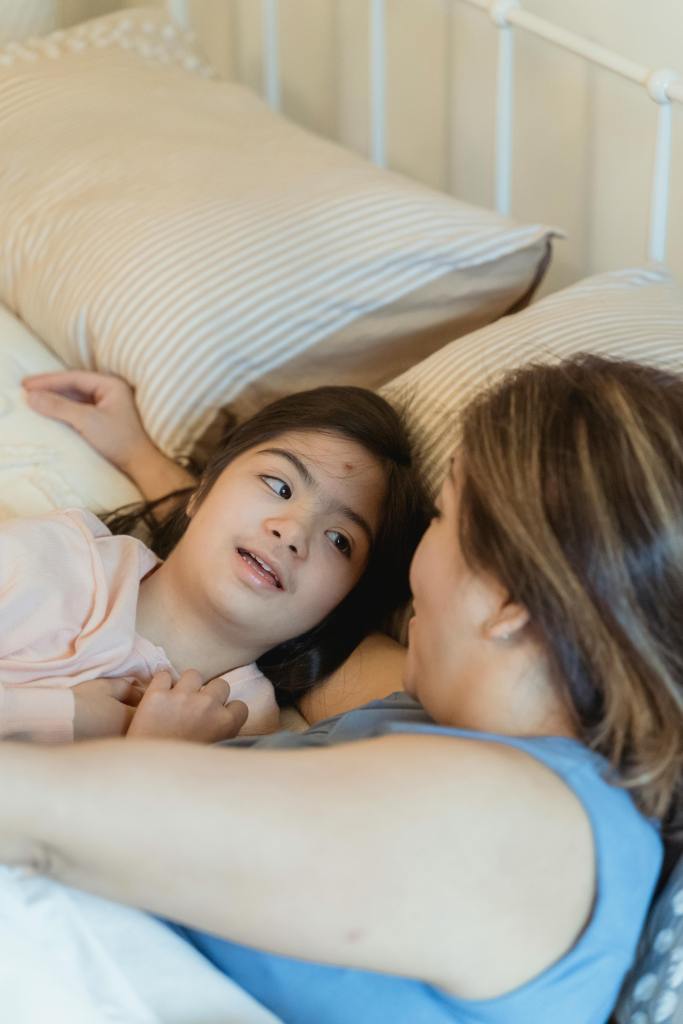
- Try brushing your child’s teeth with your child lying down in the bedroom, on either your bed or their bed.
- Maybe in the living room or dining room. With you sitting on a chair have your child sit down on the floor in front of you and lean back against your legs. Have them tip their head up so you can see inside their mouth.
- Have your child lie down on the floor. You can either sit beside your child, or put a pillow on your lap and place your child’s head on the pillow.
- Standing in the bathroom with your child standing in front of you, have them face the bathroom mirror with their head slightly tilted against your body. Place your hand gently over their hand so that you can help guide the toothbrush around their mouth.
What You Need To Get Started
- Soft-bristled toothbrush – choose your child’s favorite color or cartoon character.
- Electric toothbrush.
- Bubble gum, fruity flavored, no flavor toothpaste.
- Hand held Flossers in fun colors.
- 2 Minute Timer – A traditional fun colored plastic timer and watch the sand as your brush teeth, Play a favorite song, or sign up for the 2Minute 2X A Day App.
- Fluoride Rinse – which is available in several flavors.
Individual Preferences
- Electric toothbrush – some children like the feeling of the moving bristles in their mouth and some children do not.
- Toothpaste- if you’re concerned about the foam in toothpaste or your child doesn’t like the foamy feeling, you’ll want to consider a toothpaste without sodium lauryl sulfate (SLS).
Toothbrushing Time
In pediatric dentistry we use a technique called Tell-Show-Do. Tell-Show-Do helps us explain to a child what they should expect to see and feel.
Toothbrushing for your Autistic child is no different. Here’s how you can use Tell-Show-Do to brush their teeth ~
- Start by telling your child about toothbrushing, maybe use a Social Story or a story board you put together.
- Then show your child the toothbrush and have them touch the brush handle and then the bristles with their fingers, then rub the bristles gently on the back of their hand. You can then touch the toothbrush bristles to their lips. Ask them to open their mouth (as big as they can) and touch the bristles to one or two of their front teeth. Count together how long they can keep their mouth open.
- Place a rice grain size (if your child is younger than 3 years old) or a small green pea size (if your child is older than 3 years old) on the toothbrush.
- Next comes toothbrushing (the Do) ~
- Brush the outside, inside and chewing surfaces of the top right back teeth five times,
- Brush the outside, inside and biting edges of the top front teeth five times,
- Brush the outside, inside and chewing surfaces of the top left back teeth five times,
- Brush the inside, outside and chewing surfaces of the bottom left back teeth five times,
- Brush the outside, inside and biting edges of the bottom front teeth five times,
- Brush the outside, inside and chewing surfaces of the bottom right back teeth five times.
4 Important Tips To Remember
- Always support your child’s head,
- Have good lighting so you can see inside their mouth as well as what you are doing,
- Be able to easily move their tooth brush around their mouth, and
- Always find the safest and most comfortable position for you and your child.
What To Remember
It takes time to establish a routine, and it may take multiple revisions and repeats.
Consider talking with your child’s teacher, principal or the school district about adding daily oral hygiene to your child’s Individualized Education Plan (IEP).
It’s important to take this one step at a time, reward your child’s successes and acknowledge that somethings may need to be tweaked.
2 of the most important things to remember ~
When you get to where you want your child’s oral hygiene routine to be it will be so worth it!
Reward yourself and your child for a job well done!!
Does your child have ASD? What are your at home care challenges? How is your routine going? What are your successes? What have you learned works for your child? Tell us, We’d really like to know! Send us an email at kidstoothhotline@proton.me Like Us on Facebook
More tips? We have lots. We’re here just for kids!

 kidstoothhotline
One thought on “Overcoming Toothbrushing Challenges for Autistic Children”
Comments are closed.