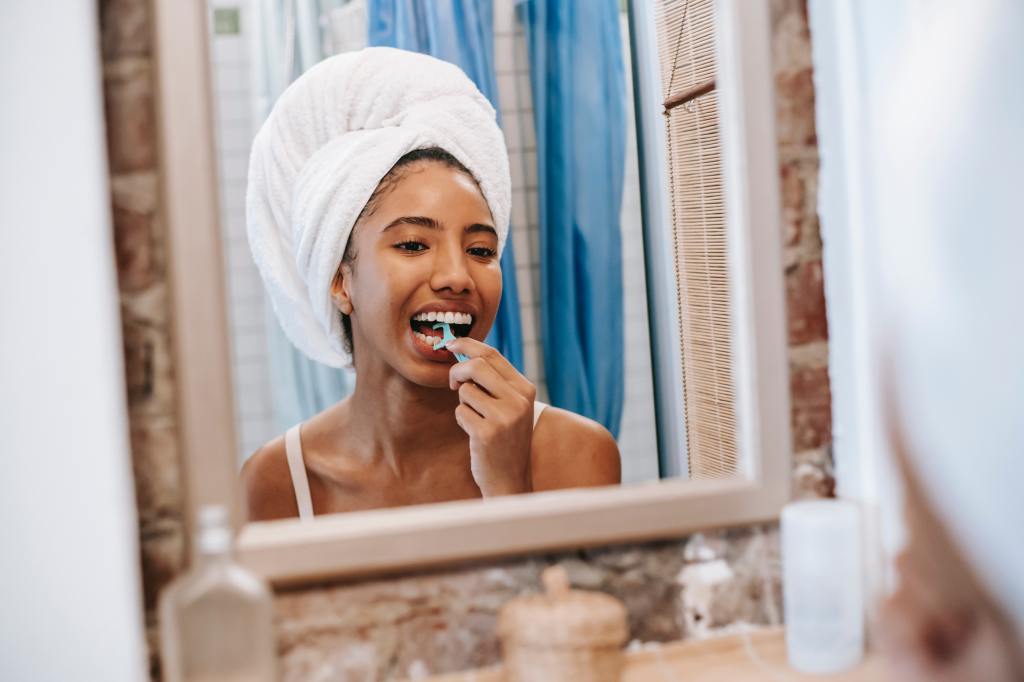
You hear it every time you’re at the dentist’s office, whether it’s for you or your child. Remember to floss, floss, floss every night.
Yes flossing is an integral part of your nightly routine. Yes it will help with good breath. Yes you’ve heard it all before.
Flossing every night before you brush your child’s teeth teaches them something valuable. In a meaningful way you are showing them that this is their nightly normal, their routine, their habit.
The best time to introduce flossing is when your child is a toddler. That’s right, from the first time they have 2 teeth touching each other. Yes, when any 2 teeth are touching.
But why is flossing a healthy habit and why is it so important to floss your child’s teeth?
Why Is Flossing Important?
Flossing is important because toothbrushing alone can’t remove everything.
Floss goes where no toothbrush can go. The bristles on a brush may look like they can go everywhere. They can’t.
This is because the bristles are too thick (really they are, no joke, totally serious). Unlike a toothbrush, floss fits in-between their teeth and along the gum line under where the teeth touch.
Toothbrush Bristles Are Big
3 Reasons Flossing Is Important
Not only does this help with cleaning all the tooth surfaces and helps reduce the risk of cavities,
Flossing helps reduce the risk of all ready formed small cavities which are in-between the teeth from getting bigger, and
Flossing helps control bad breath by removing bacteria and old food from in-between your child’s teeth.
Flossing Tip
You only want to floss 1 time a night, so keep this in mind.
Remember to floss first and brush second. This way you brush away all the stuff the floss takes out from between the teeth.
Reading With Mommy After Flossing And BrushingFlossing Helps Give Me My Beautiful Smile
What To Remember
Don’t be discouraged if this is hard when you start.
Try starting with flossing 1 or 2 teeth a night for the 1st week. Then add flossing a 3rd tooth the 2nd week. Then a 4th tooth on the 3rd week. Keep adding another tooth to floss each week and before you know it you’ll be flossing all of your child’s teeth.
You can give your child a choice about which teeth to floss, like the top front or bottom right side. Then let the flossing begin.
Remember, Congratulate yourself on your success!
Does your child floss their own teeth or do you floss their teeth? What type of flosser are you? Are you a once a week flosser? An every night flosser? Somewhere in between flosser? An only when necessary flosser? A never flosser? How old was your child when you started flossing their teeth? Tell us, We’d really like to know! Email us at kidstoothhotline@protonmail.com, Like Us on Facebook
More tips? We have lots. We’re here just for kids!
Twice a day everyday it’s Brush, Rinse, Brush, Rinse and Repeat.
With all this toothbrushing and your hectic schedule, the last thing on your mind is keeping your child’s toothbrush clean and fresh between brushings.
So how do you keep their toothbrush clean between brushing?
These are the 6 ways to take care of your child’s toothbrush. So your child’s toothbrush will help you take care of them.
Cleaning toothbrushes is easy Rinse your brushes with tap water to remove any remaining toothpaste and food particles from the bristles.
Toothbrushes like to be left out in the open Store your brushes upright and allow them to air dry. Don’t cover or put them into closed containers. A closed container keeps the brushes wet and allows bacteria to grow on the bristles.
Keep toothbrushes separate If you store your toothbrush with other toothbrushes make sure they aren’t touching or close to each other. Keep them separated to prevent cross contamination.
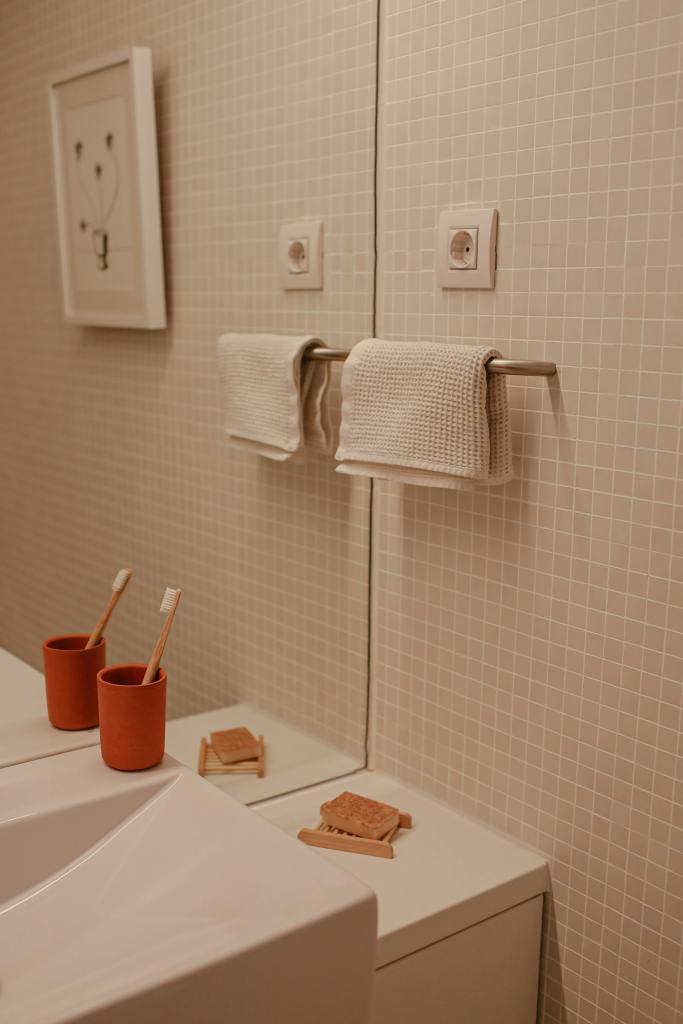
Store toothbrushes so they don’t get splashed on Keep your brushes away from the edge of the sink and counter top. This way they’re not accidentally splashed on when someone is washing their hands or reaching for the towel. It’s also a good way to help avoid getting germs on the brushes.
Sharing is not caring with toothbrushes Sharing a toothbrush means you’re also sharing germs.
Replace your child’s toothbrush every 3 months 90 days of toothbrushing for 2 minutes twice a day (that’s 180 brushings) takes a toll on a toothbrush’s bristles. The bristles become worn down, don’t do a good job with brushing and give germs a place to grow. Regularly replacing your child’s brush allows you to keep up with your good healthy habits.
What do you do to keep your child’s toothbrush clean and fresh? How often do you find you need to replace your child’s tooth brush? Share your tip with us. We’d really like to know! Send us an email at kidstoothhotline@proton.me and Like us on Facebook
Is This Where You Keep Your Toothbrushes?Good Bristles Help With Good Toothbrushing
More tips? We have lots. We’re here just for kids!
Mom You Light Up My Life Because You Are The Light Of My Life
Wishing every Mom a fabulous Mother’s Day!
To the most amazing Moms on your special day, you will always be your family’s heart and smile!
For all the diaper changes, meal times, putting up with temper tantrums, all the looking after and making every day memorable and so much fun, YOU really are amazing!
Celebrating My First Mother’s DayBestest MommyCelebrating Mother’s Day Together My LoveCelebrating Mother’s Day With My Mommy And GrandmaCelebrating My First Mother’s Day As A Glamma!Celebrating The Best Mother’s Day EverHappy First Mother’s Day!Cuddling with My Mommy On Mother’s DayHappy Mother’s Day To Every Grandma And Glamma!Cooking With My Grandma on Mother’s DayHappy Mommy’s Day From Me To YouHappy Mother’s Day GlammaHappy Mother’s Day GrandmaHappy Mother’s Day To The Best MomHaving Ice Cream With My Mom On Mother’s Day Is The BestI Love You Mommy, Happy Mother’s DayHappy Mother’s Day Mommy And Blow Out Your CandlesHappy Mother’s Day Memories With My GrandmaMom I’ll Alway’s Love You!Sending Mom All Our Love And Red RosesMom You Know I Love You, Happy Mother’s DayMy Mommy And I Share One Heart, Happy Mothers Day!My Mom Teaches Me So Many ThingsMommy And Me Taking Our Mother’s Day WalkTaking Our Annual Mother’s Day PictureThank You For Being My MommyYou Will Always Be My Most Precious Mother’s Day GiftMy Best Mother’s Day Gift Is YouSpending My Special Day With YouShowing My Grandma How Much I Love Her On Mother’s Day And EverydayI May Be One But This IS My Second Year Celebrating Mother’s Day With My GrandmaHappy Mother’s Day!Telling My Mom How Much I Love Her On Mother’s DayMom You’re The Best, I Love You Forever
More Tips? We have lots. We’re here just for kids!
My Mom And Dad Say Laughing Gas Helps Me Be A Great Patient
You want your child to feel calm, comfortable and confident for their dental appointment.
Sometimes there’s a procedure your child needs that can make them feel anxious before or during treatment. They may need more support than a gentle, caring manner to feel comfortable.
Nitrous Oxide (aka Laughing Gas) is a safe, effective medication that is used to help calm a child’s fears and enhance their capability to receive their dental treatment.
What Is Laughing Gas?
Nitrous Oxide is a mixture of two gases, oxygen and nitrous oxide.
Does My Child Go To Sleep?
A specially designed nose mask is placed over your child’s nose which allows them to breathe in this mixture. It is carefully adjusted and monitored so that your child receives the right amount to make them feel happy, calm and comfortable. This is not a sedative, so your child never “goes to sleep.”
Each Of Our Mom’s Said We Did Great For Our Dentist Appointments
How Does Laughing Gas Make My Child Feel?
The nose mask comes in a variety of scented flavors. Imagine having your choice of bubblegum, strawberry, orange, cherry, vanilla, or mint.
Your child will smell the sweet aroma and experience a sense of relaxation. They may also feel a sense of silliness and happiness. They may happily laugh. This is why this is often called “laughing gas.”
Are There Any Special Instructions?
It is recommended that your child have nothing to eat or drink for four hours before their appointment. This is so that your child will not become nauseous or vomit, which can happen with a full stomach. Bring something for them to drink after the procedure.
If your child starts coughing, sneezing, develops a runny nose, is congested, or gets sick it’s best to reschedule your appointment.
Call your Pediatric Dentist if your child begins taking any new medicine in the days or weeks leading up to your appointment.
How Safe Is Laughing Gas?
Laughing gas is very safe, and well tolerated. It has a rapid onset, is reversible, is monitored and adjusted to meet your child’s specific needs, and is non-allergenic.
Your child is fully conscious, awake and aware of their surroundings when breathing laughing gas; and they are able to communicate at all times.
Laughing gas is considered safe for children by the American Academy of Pediatric Dentistry and American Academy of Pediatrics.
Laughing gas is administered by trained Pediatric Dentists and your child is monitored throughout the entire procedure.
What To Remember
Laughing Gas is a safe and effective adjunct to dental procedures for children who are anxious and fearful. Not all children are alike, so this is tailored to your child’s needs.
Has your child had Laughing Gas for their dental treatment? Did you find it helpful? What did you like about it? What didn’t you like about it? Tell us, We’d really like to know. Email us at kidstoothhotline@proton.me, Like Us on Facebook
More tips? We have lots. We’re here just for kids!
My Mom Recorded Our Dentist Story And Now We Can Read And Listen Together
In the Know for You to Know
As a parent, you know that preventing dental related issues is important, and you also know that this is not so simple when your child has Autism Spectrum Disorder (ASD).
Some children may be fearful of new surroundings or sensitive to light and sounds or smells and tastes and do not know how to express these feelings.
Story telling is a great way to introduce new or unfamiliar experiences to your child. It’s also a way to re-introduce unpleasant experiences in a positive way.
Since we all love to tell a really good story or listen to one, today we’re helping you create your own dental social story.
Preparing Your Child To Go To The Dentist
Your approach needs to be tailored to your child’s individual needs.
For some children with ASD, it’s your calm reassuring voice talking with them about the pediatric dentist’s office, the people they’ll meet, the chair they’ll sit in, the toothpaste that’s used to brush their teeth.
Other children may like to read or look at books, some like to look at actual photos on your phone, or role play, and for some it’s your social story.
Which ever it is that works best for your child, always stay positive and keep your descriptions in small, repeatable steps.
Read A Social Story About Taking Care Of Their Teeth With Your Child
Social stories use positive, simple, straight forward language to describe the sequence of events your child will experience. The stories usually have pictures to help show the things they will see, hear, and do.
You’ll find social stories about going to the dentist, having their teeth cleaned, x-rays, and filling a cavity.
Sometimes We Talk About Our Social Story, Sometimes We Write,And Sometimes We ListenMy Daddy Is Reading To Me Our Story About My Dentist VisitHaving Fun Reading Our Story To My Sister About Going To The Dentist
Create Your Own Social Story About Going To The Dentist
Once you’ve made your child’s appointment you know when it’s best to introduce this to them.
Before you do, consider taking pictures of the street the office is on, the parking lot, the outside of the building, the office’s front door with the dentist’s name.
You might want to stop by and ask if you can take some pictures of the office to include in your social story. This way you’re showing your child what to expect step by step.
To go along next to the pictures you can include as many or as few descriptions as you feel are necessary.
Writing Your Own Social Story
Things to keep in mind when writing your social story ~
Write your story using your child’s name,
Keep it positive,
Give specific examples,
Pictures help to explain,
Leave room for questions,
All good stories include a “The End” to complete the story and so should your story.
Mommy Is So Good Explaining Our Story For My Dentist Appointment
Descriptions To Include In Your Social Story
I’ve put together a detailed list for you to choose from ~
You and I going to the Dentist and we’ll be driving down this street ,
Then we’ll park our car near your Dentist’s office,
After we park the car we’ll walk to your Dentist’s office,
The office is upstairs/downstairs/on the walk-in floor so we may/may not need to take an elevator ride; or we may/may not take the stairs,
When we get to the Dentist’s office we’ll open the door and walk in,
There is a lady sitting behind a desk. She’ll say hello to us when we walk in,
After we say hello, we’ll tell her your name,
The lady behind the desk may ask us to sit down and watch a movie, or play one of the games until it’s your turn,
When it’s your turn the hygienist will call your name,
The hygienist is the lady who cleans your teeth, she works with your Dentist,
Then we’ll all walk together to a room with a few special chairs that look like Daddy’s recliner,
The hygienist will ask you to sit down in one of these chairs,
The hygienist will tell you that this chair is special because it moves up and down and reclines back almost like a bed, but you don’t have to rake a nap,
The hygienist will tell you that the chair moves back so she and your Dentist can look at all your teeth even the one’s all the way in the back,
The hygienist will also tell you that when you’re lying back on the chair you can hold my hand and put your legs straight out,
The hygienist will ask you how big you can open your mouth, and count how long you can stay open wide,
The hygienist will show you the big light she and your Dentist use so they can see all your teeth,
Before she turns the light on, the hygienist will ask you if I want to wear sunglasses or close your eyes because the light is bright like the sun,
The hygienist will show you the special mirror she and your Dentist use to look at your teeth. She’ll let you touch the mirror and she will also show you what the mirror feels like on your lips and tongue and cheeks,
Then the hygienist will show you the tooth counter she and your Dentist use to count and check your teeth,
The hygienist will show you the special floss string she uses to clean in-between your teeth, she’ll let you touch the floss and she’ll show you how it feels in-between your fingers and then she’ll floss your teeth,
The hygienist will show you the special power toothbrush and special toothpaste she uses to clean your teeth, then she will let you touch this special toothbrush and she’ll show you what the brush feels like on your finger and then on your teeth; the best part is that the hygienist will say you get to pick the flavor of your toothpaste,
The hygienist will show you the special tooth vitamins she puts on your teeth after your Dentist checks your teeth with his mirror and tooth counter,
The Dentist may want to take special pictures of your teeth, the hygienist will explain that these photos are called x-rays and you get to wear a super special emoji apron to take the x-rays, and I get to watch you from the door,
When you’re all finished the hygienist will give you a fun bag filled with a brand new toothbrush and toothpaste, and you’ll get to choose a super special prize.
What To Remember
Your social story is a simple short story. By using encouraging words and pictures, it helps you explain to your child the people they will meet and what they can expect at their dental visit in a way that makes sense to them.
Have you heard about social stories? Have you ever created your own social story? Do you feel social stories are helpful? Tell us your social story, We’d really like to know! Send us an email at kidstoothhotline@proton.me and Like Us on Facebook
Sometimes Social Stories Make The Best Bedtime StoriesMommy’s Reading To Me The Story She Wrote About Me Going To The Dentist And I Get To Hold My TrucksStories Are Always Better With Grandma
More tips? We have lots. We’re here just for kids!

How Am I Going To Floss My Autistic Child’s Teeth?
Children’s oral health (aka dental health) is essential for their overall health and well-being. As parents, you know how important it is to prevent dental issues.
You also know this isn’t so simple to do when your child has Autism Spectrum Disorder (ASD). Especially since establishing and following a daily flossing routine is quite challenging.
Remember last week we discussed Tell – Show – Do for toothbrushing. Same goes for flossing.
Today we’re talking Tell – Show – Do strategies for your at home flossing routine.
Strategies For Your Home Flossing Routine
Almost everyone thinks you need to brush and then floss, right?
Not really. It’s actually a good idea to floss first and then brush, so this way you brush away everything that was caught in-between the teeth.
Dental Floss Choices
Hand held Flossers in fun colors and fun shaped handles
String floss (aka regular floss) waxed (recommended) or unwaxed
String floss in plain (no flavor) or fun flavors (like grape or bubblegum)
What Is Order To Floss Teeth?
Most of the time the order you’ll floss is the same as toothbrushing, since you’re going slowly and introducing flossing, it may be helpful to try this tooth flossing order ~
Top front teeth
Bottom front teeth
Top right back teeth
Top left back teeth
Bottom left back teeth
Bottom right back teeth
Flossing Steps
My Mom Is Telling Me About Flossing My Teeth
Remember Tell – Show – Do. This is the Tell and the Show steps.
Start by showing your child the floss and have them touch the floss,
Touch the floss to the back of their hand and
Then slide it gently up and down along the side of one of their fingers,.
Gently touch the floss to their lips,
Ask your child to open their mouth (as big as they can) and
Touch the floss to one or two of their front teeth,
Count together how long they can keep their mouth open.
Next Comes Flossing
This is the Do. These are the 5 steps to help stream line your flossing technique.
Whether you’re using a hand held flosser or string floss always remember to gently slide the floss between your child’s tooth and their gums.
The gums between the teeth are triangle shaped and you want to gently slide the floss to the side of the gums next to the tooth, never straight up onto the gums.
If you decide to use a hand held flosser, step 3 is where you start. Keep a tissue or two close by so you can clean off the floss as you go from tooth to tooth. You don’t want to transfer the stuff in-between teeth from one tooth to the next.
If you’re using string floss, you’ll begin with step 1.
Wrap about18 inches of floss around one of your middle fingers. Wind the remaining floss around the same finger of your opposite hand. This finger will take up the floss as you move along.
Hold the floss tightly between your thumbs and forefingers.
Guide the floss between your child’s tooth and gums using a gentle, rubbing motion. Never snap the floss into the gums.
When the floss reaches the gum line, curve it around the tooth into a C shape against the tooth. Always gently slide floss into the space between the gums and each tooth.
Hold the floss against the tooth away from the gums. Gently rub the side of the tooth with an up-and-down motion, following the shape of each tooth. Don’t forget the back of their last teeth.
My Mom Just Flossed My Teeth
4 Important Tips To Remember
Always support your child’s head,
Always have good lighting so you can see inside their mouth as well as what you are doing,
Always be able to easily move the floss around their mouth and
Always find the safest and most comfortable position for you and your child to floss their teeth.
What To Remember
Yes flossing is hard and can be a struggle, but it is important because it is the only real way to clean in-between teeth.
Introducing flossing and incorporating it into your child’s daily oral hygiene routine takes time and will take multiple revisions and repeats. Tell – Show – Do is a great way to introduce, review and reinforce flossing everyday.
The #1 most important thing to remember is to praise and reward your child and yourself for a job well done!
Does your child have ASD? What are your at home care challenges? How is your routine going? What are your successes? What have you learned works for your child? Tell us, We’d really like to know! Send us an email at kidstoothhotline@proton.me Like Us on Facebook
More tips? We have lots. We’re here just for kids!

Children’s oral health (aka dental health) is an extremely important part of healthy everyday life. As a parent, one of our first goals is to focus on prevention and at home oral hygiene routines.
For some children who have Autism Spectrum Disorder (ASD) following a brushing and flossing routine can be quite difficult. This makes establishing and maintaining these daily routines challenging.
For some children this may be due to sensory sensitivities. Other’s may have taste, touch and texture sensitivities, and for some it’s their inability to communicate which leads to frustration.
Today we’re discussing the basics on challenges and strategies for your at home tooth care routine.
Toothbrushing Challenges
Have you ever thought about the feeling of a toothbrush in your own mouth? How the toothbrush bristles feel against your lips, your tongue, your cheeks and your tooth as you brush?
Have you ever really thought about the taste, the flavor or foamy feeling of toothpaste in your mouth?
For children with Autism who have sensory and touch issues these are very real unpleasant feelings and sensations.
A toothbrush and toothpaste can be difficult for children with ASD who are sensitive to touch, smells, tastes, and textures, or do not tolerate people (including their parents) or objects near their ears, face and mouth.
Do You Really Need To Brush Teeth In The Bathroom?
Everyone thinks you need to brush teeth in the bathroom, but it is not always the best place.
Toothbrushing In A Relaxed And Comfortable Place
Try brushing your child’s teeth with your child lying down in the bedroom, on either your bed or their bed.
Maybe in the living room or dining room. With you sitting on a chair have your child sit down on the floor in front of you and lean back against your legs. Have them tip their head up so you can see inside their mouth.
Have your child lie down on the floor. You can either sit beside your child, or put a pillow on your lap and place your child’s head on the pillow.
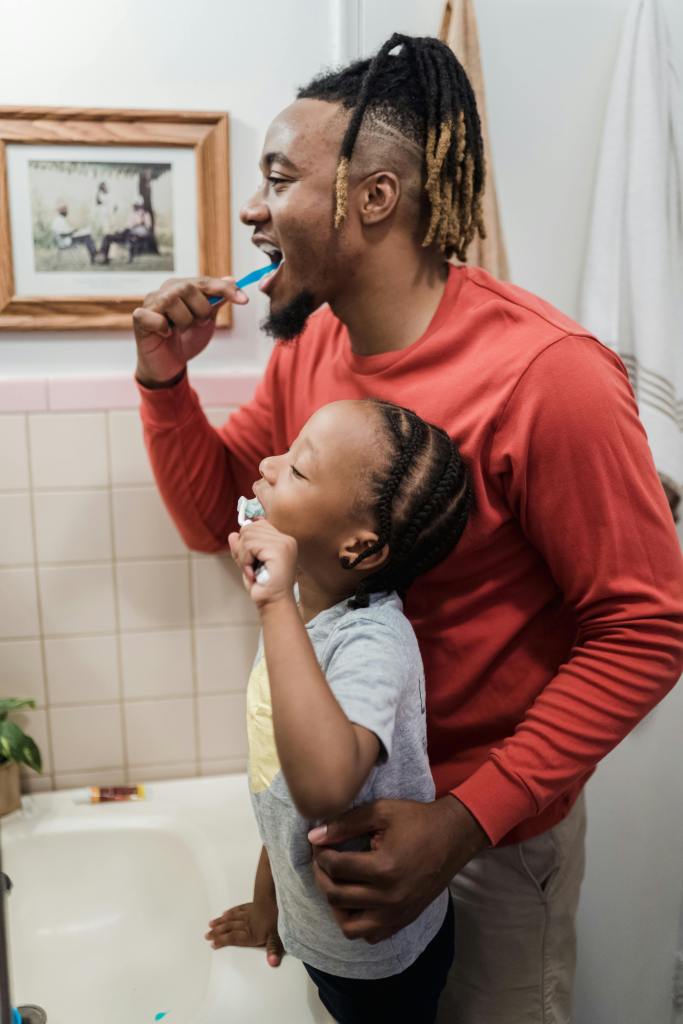
Standing in the bathroom with your child standing in front of you, have them face the bathroom mirror with their head slightly tilted against your body. Place your hand gently over their hand so that you can help guide the toothbrush around their mouth.
What You Need To Get Started
Soft-bristled toothbrush – choose your child’s favorite color or cartoon character.
Electric toothbrush.
Bubble gum, fruity flavored, no flavor toothpaste.
Hand held Flossers in fun colors.
2 Minute Timer – A traditional fun colored plastic timer and watch the sand as your brush teeth, Play a favorite song, or sign up for the2Minute 2X A Day App.
Fluoride Rinse – which is available in several flavors.
Individual Preferences
Electric toothbrush – some children like the feeling of the moving bristles in their mouth and some children do not.
Toothpaste- if you’re concerned about the foam in toothpaste or your child doesn’t like the foamy feeling, you’ll want to consider a toothpaste without sodium lauryl sulfate (SLS).
Toothbrushing Time
In pediatric dentistry we use a technique called Tell-Show-Do. Tell-Show-Do helps us explain to a child what they should expect to see and feel.
Toothbrushing for your Autistic child is no different. Here’s how you can use Tell-Show-Do to brush their teeth ~
Start by telling your child about toothbrushing, maybe use a Social Story or a story board you put together.
Then show your child the toothbrush and have them touch the brush handle and then the bristles with their fingers, then rub the bristles gently on the back of their hand. You can then touch the toothbrush bristles to their lips. Ask them to open their mouth (as big as they can) and touch the bristles to one or two of their front teeth. Count together how long they can keep their mouth open.
Place a rice grain size (if your child is younger than 3 years old) or a small green pea size (if your child is older than 3 years old) on the toothbrush.
Next comes toothbrushing (the Do) ~
Brush the outside, inside and chewing surfaces of the top right back teeth five times,
Brush the outside, inside and biting edges of the top front teeth five times,
Brush the outside, inside and chewing surfaces of the top left back teeth five times,
Brush the inside, outside and chewing surfaces of the bottom left back teeth five times,
Brush the outside, inside and biting edges of the bottom front teeth five times,
Brush the outside, inside and chewing surfaces of the bottom right back teeth five times.
4 Important Tips To Remember
Always support your child’s head,
Have good lighting so you can see inside their mouth as well as what you are doing,
Be able to easily move their tooth brush around their mouth, and
Always find the safest and most comfortable position for you and your child.
What To Remember
It takes time to establish a routine, and it may take multiple revisions and repeats.
Consider talking with your child’s teacher, principal or the school district about adding daily oral hygiene to your child’s Individualized Education Plan (IEP).
It’s important to take this one step at a time, reward your child’s successes and acknowledge that somethings may need to be tweaked.
2 of the most important things to remember ~ When you get to where you want your child’s oral hygiene routine to be it will be so worth it! Reward yourself and your child for a job well done!!
Can We Brush My Friend’s Teeth Also?See What Pretty Teeth You Have Now That We Brushed ThemAfter Guitar Practice Is Toothbrushing Time
Does your child have ASD? What are your at home care challenges? How is your routine going? What are your successes? What have you learned works for your child? Tell us, We’d really like to know! Send us an email at kidstoothhotline@proton.me Like Us on Facebook
More tips? We have lots. We’re here just for kids!

Going to the Dentist is hard. For parents whose child has Autism Spectrum Disorder (ASD) this is especially challenging.
What’s important for you to know is that dental care and oral hygiene routines will go very slowly at first. In fact, they may be non-existent.
Over time with compassion, lot’s of patience and determination at home and in the pediatric dental office achieving positive results is possible and will bring invaluable rewards for your child and for you.
Today we’re discussing strategies to help you help your child achieve successful dental care in the office.
Autism – One Size Does NOT Fit All
ASD is complex and individual. There can also be associated medical issues that your family is dealing with and need to be taken into consideration.
Some children are distant and detached from people and their surroundings, and may or may not be verbal. Other children may have repetitive routines and behaviors, unpredictable body movements, or self-injurious behaviors. There are some children who have sensory, taste and texture sensitivities. Each of these behaviors can complicate dental care and establishing oral hygiene routines.
Toothbrush Challenges
Have you ever thought about the feeling of a dental mirror or a toothbrush in your mouth? How the mirror or toothbrush bristles feel against your lips, your tongue, your cheeks and your tooth as you brush?
Have you ever really thought about the taste, the flavor or foamy feeling of toothpaste or the polishing paste in your mouth?
For children with Autism who have sensory issues these are very real feelings and unpleasant sensations.
Pediatric dental offices have all the bells and whistles for making going to the dentist fun. However they still have bright lights, loud noises and unfamiliar sights, smells and tastes.
A mirror, a toothbrush and toothpaste can be difficult for children with ASD who are sensitive to touch, smells, tastes, and textures, or do not tolerate people (including their parents) or objects near their ears, face and mouth.
I Don’t Want To Go Home
Tips For A Good Trip To The Pediatric Dentist
Call the office ahead of your visit to discuss your child’s medical history, needs and preferences. Ask if your child can tour the office before your appointment.
While you’re on the phone or during the tour, ask if the office has or if you can bring noise-canceling headphones, a weighted blanket, or sunglasses, You can also ask if your child can listen to music or watch a movie. It’s okay to ask if it would be possible to turn off the fluorescent ceiling lights in the treatment room, and/or have limited talking during the appointment. If your child has self-soothing or a repetitive routine when they’re in a new environment remember to let them know.
Some children with ASD may benefit from a gradual introduction to each step over multiple successive visits, rather than trying to accomplish everything at once. You can also ask the office if they offer introduction or “desensitization” visits to help prepare your child for their first visit, their cleaning appointment or their dental procedure.
Tell your child ahead of time they are going to the dentist.
Read a social story about going to the dentist (www.paautism.org)
Role play a dentist visit at home – You can put on disposable gloves, let your child touch them when they’re on your hands so they can feel the texture of the gloves, and practice looking in their mouth and counting their teeth. You can also do this with their toys.
Prioritize toothbrushing and flossing at home. Make a routine and stay with it. Be your child’s role model. Repetition builds habits for all children.
Encourage your child and do something fun as a reward for success at the end of the visit. (just not sweets or candy). This gives them positive reinforcement and associates the visit with something happy to look forward to.
Always be positive when talking about the dentist and their upcoming appointment.
What To Remember
Pack your patience, it may take a while to get to where you want to be.
You may have dental visits which are agonizing, hair pulling, tearful, disappointing, painful and frustrating. If something works once it may not always work twice. Each time you need to regroup and move forward.
When you get there it will be so worth it!
Autism Means LoveI Like Vanilla Ice Cream, What’s Your Favorite Flavor?I Love When My Mom And Dad Take Me On A TripMy Mom Always Help MeOur FamilyI Know What I See, What Do You See?Teach, Love And Support Children With Autism
Does your child have ASD? Do you have dental challenges? What tips will you share with us for dental visits? Tell us, We’d really like to know! Send us an email at kidstoothhotline@proton.me Like Us on Facebook
More tips? We have lots. We’re here just for kids!

When I was a dental student I first heard about specialists being Board Certified. But I didn’t know what it meant or about the process. It was in my senior year that it all came together and I understood what Board Certified meant. Not just for me, but more importantly for my future patients.
As a Pediatric Dental resident I knew that I wanted to be Board Certified. My program was rigorous. The knowledge I was gaining was boundless and there was so much to communicate.
The best way and only way was to become Board Certified. This meant that my patients would receive the ultimate in care.
As a Diplomate, we seek to acquire new knowledge and bring it to the fore front to enhance our care of children, of your child. We hold ourselves accountable to a higher standard for the greater good in making a difference for your child.
I often think back to when I was a student and before I became a mother, how would I have known what to do? Would I have known to seek out a Board Certified Pediatric Dentist for my child? What would these credentials mean? Why is it important for my child’s Pediatric Dentist to be Board Certified?
Today we’re answering those questions and discussing the importance of choosing a Board Certified Pediatric Dentist.
Why Choose A Specialist In Pediatric Dentistry?
Finding a good dentist for your child can be hard. As a parent you want the best for your child and may wonder whether you should bring your child to see a pediatric dentist or go to the dentist you usually see. You need to feel confident in making the best choice for your child and family.
This is some information to help you decide what works best for the care of your child’s oral health.
Highly Specialized Training
Pediatric Dentists are specifically trained to treat children’s developing teeth and understand the complexities of how teeth grow and develop at different ages and stages. They know the unique issues that children can face during the different stages of their growth and development.
Children generally lose their first baby teeth around the age of 6 years old and this continues with permanent teeth growing in until they are teenagers. Pediatric dentists plan and address certain issues which occur at specific growth stages.
This expanded training also includes understanding the varying childhood behaviors and helping children through their appointments in a positive and comfortable way.
Starting in infancy with the first tooth Pediatric Dentists are committed to setting children on the path for a lifetime of good oral health and positive dental experiences.
Specifically Designed Materials And Equipment For Children
Pediatric dental offices are designed specifically with your child’s needs in mind. From a bright friendly office (where we know their name), to toys and i-Pads in the waiting room, cartoons and popular children’s movies when sitting in the dental chair, and plenty of stickers and prizes to choose from at the end of their appointment. This evokes positive dental experiences where your child may not want to leave.
Not only that, Pediatric Dentists will purchase smaller sized equipment and specific materials with children in mind.
Pediatric Dentists put your child at ease by introducing everything (from examinations to equipment to procedures) step-by-step using effective child-friendly techniques such as tell-show-do without overwhelming them.
Prevention Is Our Focus
Pediatric Dentists are trained to focus on the prevention of dental problems to ensure a lifetime of good dental health.
As a pediatric specialist, we can give you advice and teach your child about developing healthy habits, such as twice a day brushing, nightly flossing and eating foods that promote good oral health.
A Pediatric Dentist also has the latest information on preventive, conservative and minimal treatments for children; such as bioactive materials and sealants.
Why Choose A Board Certified Pediatric Dentist?
You get all of the above plus more!
It’s important to know what Board Certified means so you can make an informed decision when selecting a Pediatric Dentist for your child’s dental needs.
The ABPD certifies Pediatric Dentists based on standards of excellence that lead to high quality oral healthcare for infants, children, adolescents, as well as children and adults with special health needs.
Not all Pediatric Dentists are Board Certified by the ABPD. The process of Board Certification is completely voluntary!
All dentists who complete a Pediatric Dental Residency program can practice the specialty of children’s dentistry with their certificate. However, participation and satisfactory completion of the examination process by the ABPD demonstrates a Pediatric Dentist’s pursuit for continued proficiency and excellence.
The examination process is designed to continually validate the knowledge, skills and experience that’s requisite for the delivery of quality patient care. Be confident knowing the Pediatric Dentist you choose has attained ABPD Board Certification.
Board Certification represents the highest level of credentials in the specialty of Pediatric Dentistry.
What To Remember
Board Certification marks the highest level of excellence in Pediatric Dentistry. A Board Certified Pediatric Dentist goes above and beyond to provide your child with specialized care that is specific for their oral health needs.
I May Have A Few Teeth But My Mommy Is Making Sure We Brush With Fluoride ToothpasteMommy And Daddy Give Me Yummy Healthy Foods And Brush My Teeth With Fluoride ToothpasteWe’re 2 Sisters Sharing Healthy Happy SmilesMommy And Daddy Take Care Of My Teeth So I Can Smile Pretty For The CameraI’m One And I Don’t Have Any CavitiesWe Say Brush 2 Times A Day And Floss Once A DayBrushing Teeth Is Like Learning Ballet, It’s All About TechniqueKeeping My Teeth Healthy By FlossingShowing Off My Pink Sneakers, Pink Sunglasses And Healthy TeethOur Beautiful Teeth Are The Best Gift Our Parents Could Give UsHealthy Teeth, Happy Smiles, Healthy Family
Are you taking your child to a Pediatric Dentist? Do you know if your child’s Pediatric Dentist is Board Certified? Knowing what you know now, what makes Board Certification important for you? Tell Us We’d really like to know! Send us an email at kidstoothhotline@protonmail.me Like Us on Facebook
More tips? We have lots. We’re here just for kids!

The sheer mention of the Tooth Fairy brings out joy and excitement in all of us. No matter if your child is about to lose their first tooth or you’re a pro the thought of a visit sparks amazing anticipation.
The slightest suggestion of a visit from the Tooth Fairy causes such happiness and wonder that a special day has been set aside to honor our tooth loving friend. And that day is tomorrow.
Yes tomorrow, February 28th is Tooth Fairy Day.
And the best way to celebrate the very last day of National Children’s Dental Health Month is the Tooth Fairy!
Who Is The Tooth Fairy?
The Tooth Fairy is a magical fairy who visits children when they lose a tooth and may leave them a gift.
A Poem From The Tooth Fairy
As pediatric dentists we are very close friends with the Tooth Fairy. So close in fact that she’s written a poem for us to share with you and your child on her special day ~
My Dearest Friend, I saw you wiggling in your mouth and knew a tooth would soon be mine You kept it close thinking you'd stay up all night long Then you drifted off to sleep and I began my fairy flight So into your bedroom I did come upon my fairy wings When I took a peek I found my favorite thing Now off I go, I have to dash I hope you'll send me other teeth but there is no big rush And remember my dearest friend, every time you lose a tooth another takes its place for you to floss and brush Most Sincerely, Your friend in teeth, The Tooth Fairy
When To Anticipate Your Child’s First Tooth Fairy Visit
Losing baby teeth is a super exciting time for children. Their baby teeth will begin to get looser and looser, eventually falling out, and be replaced by underlying adult teeth.
This usually begins around 6-7 years old for most children. However, some parents may start seeing loose baby teeth as early as 4 1/2 years old.
There are 2 things we often see that are helpful for you as a parent to know ~
The earlier baby teeth come in, the earlier the Tooth Fairy visits.
Girl’s teeth may come in a little earlier than boy’s teeth.
Sweet Dreams About The Tooth Fairy With My Tooth Tucked Under My PillowMom, My Tooth Is Wiggly!I Have 2 Wiggly Teeth And I Can’t Wait For The Tooth Fairy To Visit
Tips For Celebrating ATooth Fairy Visit
Some fun tips to prepare for your child’s Tooth Fairy visit ~
Make a Tooth Fairy pillow or door hanger with a pocket to hold their tooth ready for Tooth Fairy pickup.
Your child can write a letter to the Tooth Fairy, and sometimes she answers that letter and includes some of her magical fairy glitter.
Money may be expected, sometimes though the Tooth Fairy leaves a tooth friendly gift that she would really like your child to use. Since this gift is from the Tooth Fairy it gives your child extra encouragement to use this.
You may feel that you want to give your child a money gift. Sparkles and money may be the way to go. Place your gift in a home made decorated envelop and add some magical tooth fairy glitter.
The Tooth Fairy always has her trusty wand to help scoop up those precious teeth. Sometimes a tired Tooth Fairy may leave behind her wand and it gets found in their bedroom the next day.
Keep a Tooth Fairy journal to write about how they lost their teeth, how old they were, the present they received, and what they did with their prize.
Reinforce positive oral hygiene habits with the Tooth Fairy as a way to achieve this; because the Tooth Fairy (like Santa) always knows.
Think about creating your own family traditions and customs knowing the magic and excitement of the tradition will likely be more important to your child than the amount.
The Tooth Fairy Is Always Welcome At Our Home
Tooth Fairy Day Is So Nice, We Celebrate Twice
We celebrate Tooth Fairy Day twice a year, on February 28th and August 22nd.
The Tooth Fairy is one of the most powerful tools as a parent you can have to teach your child about oral health, and have fun at the same time.
You can also use the Tooth Fairy as a reminder to reinforce these good habits.
So why 2 special days? Only the Tooth Fairy knows!

What To Remember
Today you can remember your own joyful memories of your Tooth Fairy visits, when your newly lost tooth was exchanged for a surprise when you looked under your pillow the next morning. Sharing and passing along these memories with your children is a priceless way to create new and endearing memories for both of you.
Happy Tooth Fairy Day!

How does your family prepare for your Tooth Fairy visit? What treasure does your Tooth Fairy leave? What do you think the Tooth Fairy does with the teeth she gathers up each night? Tell us We’d really like to know! Send us an email at kidstoothhotline@protonmail.me Like Us on facebook at www.facebook.com/kidstoothhotline
The Tooth Fairy Came To My House Last Night
More tips? We have lots. We’re here just for kids!