Happy Father’s Day

Can I Really Prevent My Baby From Getting Cavities?

In the Know for You to Know

The simple answer is Yes. Yes, you can because tooth decay (aka cavities) is preventable.

TOP TIPS TO PREVENT CAVITIES

  • Cavities can begin just as a tooth is coming into their mouth

This is why even before your Baby gets their teeth it is important for you to clean their whole mouth, including their gums, cheeks, and tongue with a soft wash cloth after every feeding and before you put them to sleep.

Your Baby has to eat to grow. Any type of milk, formula, or juice contains sugar which may not do any apparent harm initially but once teeth begin coming in things change quickly. The sugar in these liquids adheres to each tooth’s surface and hurts the young developing teeth. Using a wash cloth or finger brush to clean these growing teeth after each feeding goes a long way and remember to lift their upper and lower lips so you can see their whole tooth.

The same goes for jam, honey, or anything sweet put on the pacifier. Once the binky is in their mouth their teeth take a sugar bath. Your baby is sweet enough. So nix the sweet stuff and keep those teeth sugar free.

  • It’s best not to put Babies to bed with a bottle

Sometimes there’s no other way for them to go to sleep. So if you must put only water in the bottle and watch them so that you can take the bottle out of their crib as soon as they fall asleep .

  • Cavities can be spread through saliva

The bacteria that causes cavities is in everyone’s mouth. It’s how they are kept in check that make the difference.

So there are 3 things you can do

1st resist the feeling to lick clean your child’s pacifier, spoon or anything that goes into their mouths, what’s in your mouth will soon be in theirs

2nd don’t share plates or utensils because sharing saliva can also share cavities

3rd while you’re making sure to clean and brush your child’s teeth don’t forget your own

  • Some times Children need to take medicine

It’s the flavorings that make children like them that are simply sugar. So what’s a parent to do? Keep a wet washcloth with toothpaste close by to wipe their mouths and teeth after the medicine is swallowed.

  • How much toothpaste?

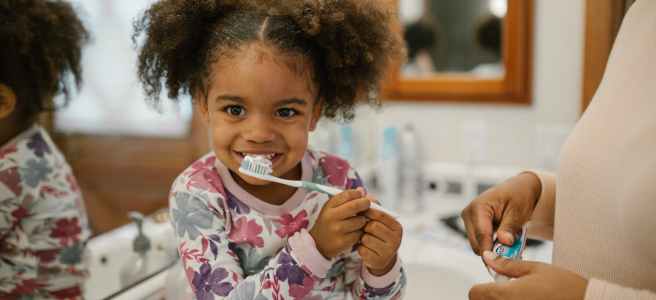
For children under 3 years old, a smear (meaning a dab) of fluoridated toothpaste on a baby toothbrush or finger brush or wash cloth is the right amount. Keep a wet wash cloth close by to wipe off the teeth.

For children from 3 to 6 years old a rice grain size (which is quite small) of fluoridated toothpaste is all you need on a small soft toothbrush, finger brush or wash cloth and with a parent, grandparent, or caregiver’s help.

The #1 way to prevent cavities is to brush your child’s teeth each and every day.

Taking care of your child’s teeth with these tips allows you to begin good oral health at an early age.

More tips? We have lots. We’re here just for kids!

Nature’s Cavity Ninja

Family Brushing Time After Trick or Treating

In the Know for You to Know

Fluoride works to help prevent cavities Fluoride is a naturally occurring mineral found in water. It’s also in toothpaste, mouth rinses, gels, varnish and supplements. In the right amount and on a regular schedule it helps prevent cavities by strengthening the outer surface of teeth. This outer surface is tooth enamel. Tooth enamel is weakened by those not so healthy foods and sweet drinks. To be effective, fluoride works its best when combined with a good diet and good brushing and flossing habits.

Fluoride is safe and effective. Did you know that water fluoridation has decreased the cavity rate by 25%? All it takes is a small amount for the maximum benefit. Proper tooth paste amounts need to be supervised by Mom and Dad, and other forms of fluoride like rinses and supplements must also be carefully monitored. Remember not to leave anything within reach of those inquisitive hands since the flavors that encourage children to brush are also tempting to eat.

For infants and toddlers starting to get their teeth and aren’t able to spit out, you can put a tiny dab of fluoride toothpaste on a washcloth or soft baby sized toothbrush. Once your child is old enough to fully spit out in the bathroom sink, a rice grain size dab of toothpaste with fluoride on their toothbrush is the right amount. School age children, tweens, and adolescents only need a pea sized amount of fluoridated toothpaste on their brush. It’s always important to closely supervise your child’s brushing so they don’t swallow the good tasting toothpaste.

Well Water Mystery Some wells have too little fluoride while others have too much. Bottled, filtered, spring and well waters all vary in their fluoride amount. So what do you do? It’s important to have the water from your well tested for fluoride every year. If you’re not sure if you have well water or town/city water, check with the local water utilities company. If you know your town/city supplies your drinking water you can also check the fluoride level by calling them.

Children between the ages of 6 months and 16 years may or may not need supplements, depending on how much fluoride is in your water, So ask for your water report.

Unlike most other medicines, fluoride dosage corresponds to a child’s age, not their weight. It also depends on the amount of fluoride present in your drinking water. This is why it is so important to have your water tested; so that your child is prescribed the appropriate dose.

Topical Fluoride Topical fluorides come in a number of different forms. There are rinses, gels, foams and varnishes. The flavors and colors are endless, as are how they are used. Some are over the counter and some are by prescription. Those over the counter products are not recommended for children under the age of 6.

Also remember to check the labels for fluoride amounts in your Baby’s powdered and pre-made formulas, as well as in their cereals.

Tell us your Ninja story – We’d love to hear

More tips? We have lots. We’re here just for kids!

Celebrating National Dentist’s Day

In the Know for You to Know

What is National Dentist’s Day? Is there such a holiday?

Yes there is. National Dentist’s Day is celebrated on March 6th every year. It was established to show appreciation to Dentists for all they do in giving good care and keeping your family healthy.

Here are a few ways for you to celebrate –

Brush your and your child’s teeth for 2 minutes 2 times a day and remember to floss. Then take a family selfie showing off your pearly whites.

Celebrate with your children by making and enjoying a healthy tooth friendly meal together. Let us know about your meal.

Spend time together doing arts and crafts and learning about teeth and sugar bugs. Tell us what you learned.

Compose some cool tooth brushing songs with your children. Let us know about your creations.

Make your grocery store list. When choosing snacks be sure to read the labels and choose healthy low sugar snacks. Let us know which are your favorites.

What do we love most about Pediatric Dentists?

They help us put our best SMILE forward. Smiles are the first thing that gets noticed and healthy sparkling teeth allow us to feel our best.

Now go ahead, you know you want to SMILE!

More tips? We have lots. We’re here just for kids!

Answers to Your Questions about Alternatives to Tooth Whitening and Whitening Toothpastes

In the Know for You to Know

Today I am answering questions in follow-up to my last post on Tooth Whitening. With so many great questions I have selected those which represent what you want to know.

Karly from Missouri wrote in asking – I went for it and let my 18 year old twins have their teeth whitened for the holidays and now they want to go back again. I’ve seen whitening toothpastes, are they effective? Whitening toothpastes only remove superficial staining on the top surface of teeth. These toothpastes are toothpaste and do not whiten teeth like the bleaching service your children had at the Dentist. The toothpastes have an abrasive in them that polishes teeth so over time they lighten but do not change the color of teeth.

It’s best to use these pastes for a once a day use and your regular toothpaste for the other brushing. Remember to always use toothpaste with the American Dental Association (ADA) Seal of Acceptance.

Chloe from Minnesota wrote in asking – Our Dentist keeps talking about different types of stains when I ask him why my daughter’s teeth are yellow. She’s a teenager, so what is he talking about? Adult teeth are not that beautiful pearly white that baby teeth are, no matter how old your daughter is. There are 2 types of stains. The stains on the top surface are called extrinsic stains, while staining inside the tooth are called intrinsic stains. The causes and how the stains are taken care of are totally different.

Think about and look at pictures of her teeth from when they first came in until now. Have they always looked this way? Did something happen that changed the way they look? How are we doing with our flossing and brushing routine? Is this something you’re just noticing now?

Ethan from Virginia wrote in asking – I had my teeth bleached and now my 12 year old wants his done also. Is he at a good age to have this done? While some children at 12 years old may have all their adult teeth in their mouth the roots of these teeth are not fully formed and that is very important because of the effect on root development. For the children who have a combination of adult and baby teeth, they are in their mixed dentition. Which means that a lot of new adult teeth which are not in their mouths yet are forming, especially the roots.

While there needs to be more research on whitening for children, tweens, and adolescents, it’s always good to keep up with flossing and brushing and re-evaluate in another year to two.

Andrew from Illinois wrote in asking – We were told that bonding is the best way to go for changing the color of my daughter’s teeth. I thought this was used for cavities, but she doesn’t have cavities. Help! Bonding might be an option for children with discolored teeth. The procedure itself is called bonding, and it is a multi-step process which uses a color matched composite resin to cover the tooth with a thin coating of plastic-like material. After the coating is applied it is sculpted, shaped and polished to provide a pleasing result.

There are some limitations. Bonded teeth are not as strong as natural teeth. Nail biting, biting into food, any kind of accident to the mouth can damage bonded teeth. The composite itself can become discolored and worn over time, and a bonded tooth can not be whitened.

Emilia from Pennsylvania wrote in asking – What are your thoughts about Baking Soda and Charcoal for tooth whitening? Enamel is the thin outer layer covering teeth. For Baby teeth enamel is 1/2 to 1 millimeter thick, and Adult teeth have a thickness of 1 to 2 millimeters. This is very thin, and enamel does not reform.

Baking soda and charcoal are abrasive. They wear away enamel and can make teeth look more yellow than white. More yellow? Yes, because when enamel is worn away the layers underneath are exposed and those layers have yellow color tones.

Mateo from Connecticut wrote in asking – Are there side effects to using tooth whiteners? There needs to be a lot more studies on whitening and its effects on children, tweens and adolescent’s teeth and gums. For the oldest adolescents who do undertake a whitening regimen-BE CAREFUL.

Watch out for tooth sensitivity, gum irritation and even harm to the nerves in the teeth. These effects can be localized or full mouth and due to inflammation and harming tooth structure. How long they last is individual. As always be careful!

Thank you to everyone who reached out with your questions!

Don’t be shy, SEND IN your questions or tell us what you’d like more information on, we’d love to hear from you!

More tips? We have lots. We’re here just for kids!


5 Fast Facts for your Child’s Teeth

In the Know for You to Know

FACT 1 Baby teeth are important and for several BIG reasons. Baby teeth are also called primary teeth or milk teeth and help your child learn where to put their tongue and cheeks so that they can speak clearly, allow them to chew their food well, help in the growth of both their jaws, and guide the position of their adult teeth. That’s a lot of responsibility for 20 teeth!

FACT 2 Your child can get cavities from their bottle and from nursing. Please don’t put your child to bed with a bottle or nurse them while they are sleeping. The liquid in the bottle or breast milk causes cavities because it stays on their teeth. So the sugar in the milk, juice, breast milk in their nice warm mouth eats away at their teeth. That’s why we call them “Sugar Bugs”.

FACT 3 A dab ‘ll do ya with toothpaste. From your child’s first tooth until they are 2 years old a tiny smear is enough. For your 3 to 6 year old a pea sized amount of toothpaste is plenty. As your child gets older they don’t need more than the pea sized amount. Remember to directly supervise their brushing routine, get in there with them and sing that brushing song. Louder, I want to hear you! What are your favorite brushing tunes?

FACT 4 It’s best to let that wiggly teeth come out on its own. If your child wants to help it along, allow them to gently wiggle the tooth with their fingers or tongue until it comes out on its own. Do not pull or put anything else on the tooth to help it along which will be painful and cause their gums to bleed. If you see an adult tooth growing in and that baby tooth isn’t wiggly or is slightly wiggly call your Pediatric Dentist for their guidance. So tell me, what is your tooth fairy tradition?

FACT 5 Sealants really do work. Even with really good brushing and flossing sometimes it’s impossible to clean the tiny grooves and pits on some teeth. Food and bacteria build up in these crevices and before you know it there’s a cavity. Sealants “seal out” food and plaque reducing their tooth’s risk of decay. Are you joining the No Cavity Club?

Go ahead, send me an email at kidstoothhotline@protonmail.com and tell me your favorite brushing song, your tooth fairy tradition, and if you’re joining the no cavity club. I love to hear from you!

More tips? We have lots. We’re here just for kids!

Excited to go to the Dentist

Brushing My Teeth With My Mom

In the Know for You to Know

Has your child told you how excited they are to go to the Dentist?

That they can’t wait to have their teeth counted and tickled?

What flavors will they pick to treat their tongue and bedazzle their smile?

What prizes will they choose and what will their goodie bag hold?

As a parent you know it’s about more than teeth, it’s about the experience,

Your experience in a place that is fun, magical, educational, comfortable and familiar.

This is the world of Pediatric Dentistry, This is the world for You.

Wishing you all my best for an amazing holiday season!

More Tips? We have lots. We’re here just for kids!

Healthy Holiday Teeth

In the Know for You to Know

During holiday time many parents are concerned because this is the season of temptation, filled with lots of sugary treats. Here are my 5 top tips for a healthy approach to the holidays~

Maintain a balanced diet of all the major food groups. This includes fresh fruits and vegetables, whole grains, milk, dairy, eggs, lean meat and fish. For non-meat eaters, do not forget about your proteins. There are so many plant based protein substitutes available in your supermarket’s fresh and frozen aisles that it can be difficult to choose which to try first.

It’s okay to allow a limited selection of special treats. This is what makes the holidays special. Moderation is the key. As always, remember to floss and brush those goodies away.

Avoiding sticky and chewy foods, like dried fruits or toffee is a good idea, since they have more cavity causing power.

If you have an infant or young child drinking from a bottle or sippy cup don’t allow holiday traveling and schedule changes to disrupt your good habits. Remember not to let your child fall asleep with the bottle or sippy cup since the liquids stay in their mouth and can cause cavities.

You are your family’s cheer leader. Encourage, remind and reinforce good flossing and brushing habits even with your hectic holiday schedule.

Enjoy a Healthy, Happy and Safe Holiday!

More Tips? We have lots. We’re here just for kids!

Dental Care for Your School Age Children

My Mom Is Teaching Me How To Brush My Teeth

In the Know for You to Know

Why are regular dental check-ups so important?

Check-ups every 6 months are a time to talk about your oral hygiene routine and the increasing role your child is taking in their own oral health. It’s discussing fluoride, your child’s diet on their teeth, habits, and what you can expect in terms of growth and dental development. And depending, we may talk about sealants.

What should we be doing at home?

Supervise, encourage and model your child’s daily flossing and brushing routine. This allows you to reinforce why they need to brush for a full 2 minutes twice a day and floss before brushing each night. There’s lots of fun ways to brush, check out 2min2x.org.

Teething Again?

In a different way. Now it’s the Adult teeth which are coming into their mouths. Around the age of 6 bottom and top front teeth come in followed by the very back (behind the baby teeth) molars. Age 7 it’s the side teeth. Between 9 and 11 years old the eye teeth (canines) come in. Around 12 their second set of adult molars comes in, and you guessed it, they are called the 12 year molars. Around this time their baby molars are being replaced with their premolars.

Are children afraid of the Dentist at this age?

Yes and no. Some may cry, others may be hesitant, and others will be happy to be there. If you have concerns talk with your Pediatric Dentist. Pediatric Dentists are experts in how to make dental visits a positive experience for your child.

When are X-rays taken?

Pediatric Dentists follow the protocol established by the American Academy of Pediatric Dentistry. There are certain times when it is important to take an x-ray and the information we see is valuable in helping take care of your child. Be assured that dental x-rays are very safe, we’ve come a long way in technology.

Are mouth guards important?

In one word, Yes. Children this age are starting to participate in gym, recess, after school athletics, and/or school sports, so it’s important to be aware of injury prevention. A mouth guard is recommended at this age for any sport that leads to contact with a surface or another person. For the same reason children wear helmets and shin guards, or use foam mats as part of their equipment they also wear a mouth guard, and that is for their Safety.

Remember Your Goal

With good oral care at home and regular twice a year check-ups your child has the potential to become an adult without ever suffering from a cavity or other oral health issues. This is priceless.

More tips? We have lots. We’re here just for kids!