The Children's Dental Blog for Mom's and Dad's about All Things That Matter
Author: kidstoothhotline
As a Board Certified Pediatric Dentist with over ten years of experience practicing Pediatric Dentistry, I understand that parents and caregivers are in need for information to care for their children's oral health. You may not have your normal lines of communication open or you cannot easily call or visit your child’s Dentist and obtain answers to your questions. Some families may not yet have a Pediatric Dentist to call.
My expertise and knowledge can help serve as your source as I provide answers with information that is current, informative and the Gold Standards of Care which are the practice Guidelines approved by the American Academy of Pediatric Dentistry.
I want to help you access this important information by answering your questions through this site. You may want to submit your own individual questions or you can view my postings and answers to other families questions that may apply to your child's needs.
I am committed to helping you stay informed, after all it is all about your child.
Wishing you a happy and memorable Independence Day filled with food, fun, friends, fresh air, sunshine with a whole lot of smiles, and lots of ice cream (just a reminder to floss and brush).
Best 4th of July Picnic EverWatching Fireworks On Independence DayEnjoying Our Special Cupcakes Made For The 4th Of JulyHappy July 4thWe’re Having So Much Fun At Our 4th Of July PicnicWhat’s On Your BBQ Menu For July 4th?Our Parent’s Set Up A Picnic Just For UsWatching Beautiful Fireworks On The 4th Of JulySo Many Yummy Red, White And Blue Treats For Our July 4th Picnic
From all of us at Kidstoothhotline to each of you ~ Happy 4th of July!
Amazing Fireworks For The 4th Of July
Have any family plans for the 4th? Watching fireworks? What’s on the BBQ? Which ice cream flavors are tops in your house? Tell us, We’d really like to know! Send us an email to kidstoothhotline@proton.me Like Us or chat with us on Facebook
More tips? We have lots. We’re here just for kids!
Open Big And Say Cheese Just Like Counting My Teeth At My Pediatric Dentist’s Office
As parents you want to soothe any dental anxiety and remove fears of the dentist for your children, and one of the best tools at your disposal is knowledge.
Keeping descriptions simple, easy going, and relatable is always important no matter what your child’s age. Using child friendly words when explaining the people they will meet, the sites, sounds and instruments (aka tools) go a long way to easing your child into their dental visits.
Today we’re breaking down the basics on how to keep things simple, honest and understandable when preparing your child for their visit with the pediatric dentist.
Child Friendly Language Is The Key To Creating A Fun And Positive Dental Experience
Each visit is an opportunity for you and your pediatric dentist to create a positive dental experience for your child. Fun and self-explanatory word exchanges allow for understanding and encourage confidence toward dental appointments.
Child Friendly Dental Words
Adult Dental Words
Child Friendly Dental Words
Dental Chair
Recliner
Dental Chair Light
Flashlight
Saliva Ejector
Mr. Thirsty or Straw
Dental Mirror
Looking Glass
Explorer
Tooth Counter
College Pliers
Picker Uppers
Air Water Syringe
Water Squirter or Super Soaker or Wind & Water
Examine Teeth
Counting Teeth
Cleaning
Tickle Teeth
Prophy Brush
Tooth Tickler or Electric Toothbrush
Prophy Paste
Yummy Flavored Toothpaste
Floss
Tooth String
Fluoride
Tooth Muscles or Tooth Vitamins
X-ray Machine
Camera
Intra-oral Sensor
Tooth Selfie or Photo
Lead Apron
Emoji Cape or Superhero Cape or Blanket
Cavity
Sugar Bugs
High Speed Handpiece (aka fast drill)
Mr. Whistle or Airplane
Slow Speed Handpiece (aka slow drill)
Mr. Bumpitty Bump or Motorcycle
Bur
Shower Head
Injection
Sleepy Juice For Teeth
Topical Anesthetic
Jelly or Spicy Jelly
Remove A Tooth
Tooth Dance or Tooth Wiggle
Infection
Bubble
Rubber Dam
Raincoat
Rubber Dam Clamp
Tooth Ring
Isodry or Isolite
Mr. Fish or Tooth Pillow
Nitrous-Oxide Oxygen
Magic Air
Nitrous Oxide-Oxygen Nose
Ice Cream Nose
Curing Light
Tooth Dryer or Magic Light
Crown
Chapeau or Fancy Hat or Baseball/Football Helmet
Space Maintainer
Tooth Jewelery
Sealant
Tooth Polish
Child Friendly Dental Words
A Big Thumbs Up To My Pediatric Dentist For Being Creative In Helping Me Understand Everything TodayToday Is My Dentist’s Appointment And I Can’t Wait To GoTelling Daddy About The Fun Words I Learned At My Pediatric Dentist Visit TodayDaddy’s High Five With Me For Having Such A Great Visit With My Pediatric Dentist, Thank You DentistMommy Is Showing Me How Much Fun I’m Going To Have At My Pediatric Dentist Appointment TodayMy Mommy Is Tickling My Tummy And My Pediatric Dentist Will Tickle My TeethThumbs Up To My Pediatric Dentist For Helping Me Today, And For Being Such A Good Helper I Get Extra Game TimeMy Pediatric Dentist. Makes Me So Comfortable When They Use The Mirror And Tooth Counter To Check My Teeth, No Matter How Old I GetI’m Drawing A Thank You Tooth For My Pediatric DentisMommy Is So Happy Since I Listened So Well To What My Pediatric Dentist Explained To Me At My Visit TodayThumbs Up To My Pediatric Dentist For Counting My Teeth and Using The Tooth TicklerMy Pediatric Dentist Did A Great Job Explaining Everything To Me, So I Was A Really Good Helper And Daddy’s Proud Of Me-High 5 DaddyThumbs Up For The Best Dentist Appointment EverBlowing Bubbles With My Prize From My Pediatric DentistThumbs Up To Me For Being Such A Good Listener At My Pediatric Dentist’s Appointment YesterdayWe’re Dancing Our Way To Our Pediatric Dentist
What To Remember
It’s not what we say but how we say things that make all the difference. Effective language is key to having a positive experience. As children grow and mature pediatric dentists tailor their explanations to be age appropriate.
No matter what their age, children remember the fun words at the dentist as they grow which helps them have a positive experience and attitude for their dental visits.
Before you know it they’ll be saying to you “I remember when you explained to me about Mr. Whistle and the sugar bugs, by doing that you made it so easy for me at the dentist.” Now that’s empowerment.
I’m Giving My Pediatric Dentist A Thumbs Up For Explaining Everything So I Wasn’t Nervous TodayMy Children Just Had The Best Pediatric Dental Appointment
How do you prepare your child for their dental visit? Have you come up with any fun words to explain to your child their upcoming appointment? Which are your favorite children’s dental terms? Tell us, We’d really like to know! Send us an email to kidstoothhotline@proton.me Like Us or chat with us on Facebook
More tips? We have lots. We’re here just for kids!
My Zirconia Crowns Are As Pretty As My New Teddy Bear
You’re at your child’s dental check-up and you find out that the tooth you thought has a cavity does have one and that a filling just won’t do.
In my last post about crowns, we discussed stainless steel crowns. Stainless steel crowns are the classic reliable standard for taking care of baby (aka primary) teeth when placing a regular filling puts a tooth at risk for breaking. But let’s face it, they are not very esthetic.
When esthetics is a concern, there is another option and that is the zirconia crown.
Today we’re breaking down the basics on an esthetic children’s tooth crown alternative, the zirconia crown.
What Is Zirconia?
Zirconia is a high quality ceramic material which closely resembles natural teeth, providing durability and a natural appearance.
What Is A Zirconia Crown?
White zirconia dental crowns are an esthetic alternative to stainless steel crowns for children.
In addition to being metal free, strong and biocompatible, they are esthetically pleasing since they can blend in with your child’s natural teeth; whether back teeth or front teeth.
These crowns are for restoring primary teeth that are chipped, damaged, broken, not developing properly, have had a pulpotomy, or have areas of tooth decay (aka cavity) which are too large for a filling because of the risk of breaking the tooth.
Smiling Pretty With My Mommy After Getting My New Zirconia CrownMommy And Me Reading Up On Zirconia CrownsShowing Grandma My New Zirconia CrownsMommy’s So Proud, My Brother Did Awesome For His Zirconia Crowns TodayCan You Guess Which Of My Teeth Have Zirconia Crowns?I’m Showing My Zirconia Crowns To My FriendCan You See My Zirconia Crown?Mommy and Me Looking In The Mirror Checking Out My New Zirconia CrownI’m Cuddling With My Mom After Getting My Zirconia Crown Today
How Long Does A Zirconia Crown Last?
Zirconia is very strong and well suited for children who need their crowns to last for several years until they naturally lose their baby teeth.
How Do We Take Care Of A Zirconia Crown?
Your child’s daily brushing and flossing routine has the same importance now as it always has, and with increased emphasis now that your child has a crown.
It’s best to avoid biting anything hard, sticky, chewy and gooey since they can dislodge the crown or pull it off completely.
Are The Reasons For A Zirconia Crown Different From A Stainless Steel Crown?
The reason for a children’s tooth crown, whether it is a zirconia crown or a stainless steel crown are the same.
I’m Showing Off My Zirconia Tooth CrownCan You Guess Which Are My 2 Zirconium Crowns?Mommy Said I Did Great For My Zirconia Crowns
5 Indications For A Children’s Zirconia Crown
Tooth decay has caused so much loss of tooth structure that a filling will break, break the tooth even more, or both,
A tooth that grew in with weak structure (not due to a cavity),
Esthetics are a concern.
When Isn’t A Zirconia Crown Recommended?
There are 4 specific times when a Zirconia crown isn’t advised~
When a child grinds their teeth,
When there is space loss between the tooth needing the crown and the adjacent teeth,
When there is too little tooth structure remaining to retain the crown on the tooth,
When there is substantial crowding between the teeth.
What To Remember
Baby teeth may be small but their need is great.
This is because children’s primary teeth are essential for chewing, speaking, and maintaining space for the development and correct positioning of their adult teeth.
Zirconia crowns are a good treatment choice for these important teeth for 4 reasons ~
They have good retention,
They are fracture resistant,
They are oral hygiene friendly,
They have parent’s satisfaction and increase children’s self-confidence.
I Really Like How My Zirconia Crown Looks
Have you been told your child needs a crown? Are you concerned about the crown’s esthetics? What do you think about zirconia crowns? Do you feel comfortable discussing zirconia crowns with your child’s dentist? Tell us, We’d really like to know! Send us an email to kidstoothhotline@proton.me Like Us or chat with us on Facebook
More tips? We have lots. We’re here just for kids!
A Father gives his heart, his smile and his love. He is someone you always look up to no matter how tall you get.
Happy Father’s Day To The Best Dad!Wishing Our Fathers A Happy Father’s Day!We Love Father’s DayMy Dad’s Teaching Me To Ride My 2 WheelerMy Dad’s Teaching Me How To CookMy Daddy’s and My Father’s Day DanceMy GrandDad Loves Teaching Me About CarsOur First Father’s DayMy Dad Just Told Me How Proud He Is Of Me! Love you Daddy!Just Like My Daddy, Happy Father’s Day DaddyI’m Making My Dad His Father’s Day CardI’m Always Learning Something New From My DadI May Be Getting Married But I Want My Dad By My SideGrocery Shopping Is Fun With Our Dad, Happy Father’s Day DaddyBiking With Our Dad On Father’s Day MorningHanging Out With My Dad Is How We Make Memories Father’s Day And EverydayFather’s Day Breakfast Is Always So SweetGirl’s Dad RuleI Help Prepare Father’s Day Dinner Every Father’s Day
Your children will always remember and be grateful for you. You are their guiding light, their super hero, their pillar of strength and love.
Our very best wishes to every amazing Dad on your special day!
Our First Father’s DayDaddy And Me Chilling Together On Father’s DayMy Daddy Always Makes Me LaughPlaying With My Big Strong DaddyOur Official Unofficial First Father’s DayWe’re Making Our Father’s Day MemoriesOur Dad Is A Super DadMy Daddy’s and My Father’s Day DanceMy Daddy’s Always Got His Eye On MeWishing My Grandpa A Happy Father’s DayHappy Father’s Day Daddy, You’re The BestCoolest DadMy Daddy’s Taking A Nap
From each of us at Kidstoothhotline to your Family ~ Happy Father’s Day!
Blowing Bubbles To Wish My Dad A Happy Father’s DayA Dad’s Love Is His Greatest GiftFather’s Day Memories Of Hanging Out In The Hammock Talking With My DadI’m Planting This Tree On My First Father’s DayLove You Daddy!Learning To Drive With My DadMy Hand In Your Hand Forever
Tell us how you’re planing on spending your special day! What are your Father’s Day traditions? Are you starting new traditions this year? Let us know what always makes you smile on Father’s Day. We’d really like to know. Send us an email at kidstoothhotline@proton.me Like Us or Chat with us on Facebook
More tips? We have lots. We’re here just for kids!
Why Am I Going To The Dentsit For A Crown? I’m Already Wearing One
You take your child for their regular dental check-up appointment and you’re feeling good this time but you still have this feeling they may have a cavity or two.
The hygienist asks you to come over and the pediatric dentist begins to discuss the best way to take care of the tooth with the big cavity. Yes, that tooth. The tooth all the way in the back that has been a challenge to floss and brush.
As the dentist is talking with you, you’re thinking “maybe a filling, a smallish filling, after all it’s a baby tooth and not very big.”
Then you hear the words “cap” and “crown.” You’re surprised and thinking “oh no, what?, how?, you’ve got to be kidding.”
This isn’t a ploy. There are times when a child’s tooth may have a cavity, a developmental defect, or a fracture and the best way to restore the tooth is with a dental crown.
Today we’re breaking down the basics on a commonly used dental crown for children, the stainless steel crown.
What Is A Dental Crown?
A dental crown is a tooth shaped cap that restores a decayed or broken tooth.
The crown fits over the entire tooth (like a hat covers your child’s head) and is contoured to ensure a proper fit.
Why Does A Baby Tooth Need A Crown?
Baby Teeth (aka primary teeth) are important to take care of because they help with proper speech development, chewing, and maintaining space for adult teeth to come in correctly.
When a baby tooth has a cavity, or defect, or is fractured the structure of the tooth is weakened and can easily break; which causes another set of issues.
Covering the tooth with a crown gives support and structure while preserving the tooth’s form and function.
What Are The Reasons For A Dental Crown?
Tooth decay (aka cavities) is very prevalent among children, and the extent of the cavity is the most common reason for a crown.
There are several additional indications for why a child needs a dental crown —
The decay has caused so much loss of tooth structure that a filling will break, break the tooth even more, or both,
The tooth has developmental defects that compromise the structure of the tooth,
A fractured tooth
I Had To Have 2 Silver CapsMommy And Daddy Say This Is Why I Need Silver Caps On My MolarsMy Mom Said At least I Only Needed 1 Silver Crown, My Brother Needed 4
What Is A Stainless Steel Crown?
Stainless steel crowns are a metal crown which are pre-formed, resemble the anatomy of the tooth and can be contoured to the tooth. The crown is then affixed onto the tooth with a special dental cement.
A stainless steel crown is the most traditional type of crown for baby molars. The reason is that they are designed to last for several years until the baby tooth falls out. They are very durable, and adapt very well to the tooth.
What Is A Stainless Steel Crown Made Of?
Stainless steel crowns are manufactured using a stainless steel alloy which contains nickel and chromium.
If your child has any sensitivity or allergy to any of these materials it’s important for you to speak with your pediatrician and pediatric dentist before your child’s crown appointment.
How Long Does A Stainless Steel Crown Last?
A stainless steel crown is placed to help restore form and function to a baby tooth (most typically a baby molar), and lasts as long as the baby tooth.
The tooth and the crown usually come out together, which can be around the time your child is 10 to 14 years old.
Grandma Do You Remember When I Had All Those Silver Crowns In My Mouth? I Learned My Lesson
How Do We Take Care Of A Stainless Steel Crown?
Floss and brush around the tooth with the crown just like all your child’s other teeth.
It’s best to avoid sticky, chewy and gooey candies since they can dislodge the crown or pull it off completely.
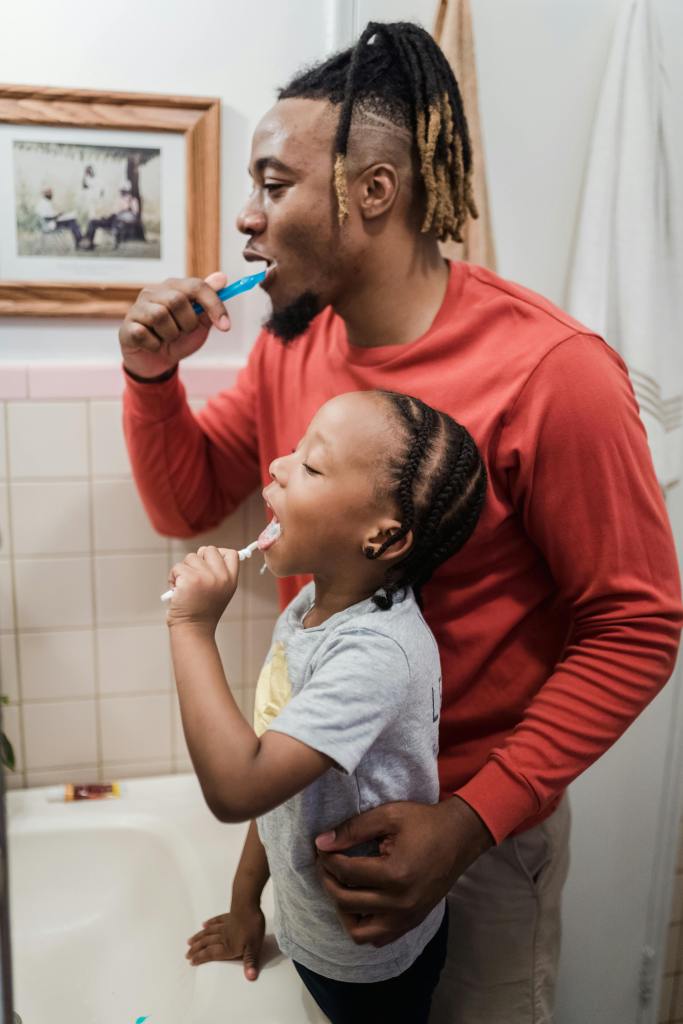
Daddy’s Helping Me Brush My Teeth So I Won’t Have To Get Any More Silver Crowns
Is There An Alternative To A Stainless Steel Crown?
While stainless steel crowns are the gold standard for children’s molar teeth, there are other options available, such as stainless steel crowns with a pre-veneered tooth colored white facing and zirconium crowns.
Stainless Steel Crown With Pre-Veneered White Facing
Stainless steel crowns can be made to look more esthetically pleasing with a pre-veneered tooth colored plastic face.
These crowns appear more cosmetic because from the front they look “tooth colored” but the area around the facing, the biting surface, the sides and back of the crown are all the traditional silver color.
For the tooth colored facing to adhere to the metal crown extra bulk is added, so these crowns look thick and round.
The facing also has an increased tendency to easily break off exposing the silver underneath.
Zirconium Crowns
Stay tuned for my upcoming post on these new for children highly esthetic crowns.
What To Remember
The care of baby teeth is essential due to their role in chewing, speaking, and maintaining space for the development and correct positioning of adult teeth.
While baby teeth may be smaller in size than adult teeth, tooth decay, structural defects and fractures loom larger for them.
Stainless Steel Crown’s are the treatment of choice for primary teeth for 3 important reasons —
Durability,
Longevity,
Reliability.
Mommy Had Silver Caps in Her Mouth When She Was Little, I’m Making Sure My Precious Angel Never DoesI Got A Tooth Crown And Princess Crown Today
Does your child have a stainless steel crown? What were your thoughts when you heard your child needed a stainless steel crown? Did you have a stainless steel crown as a child? Tell us, We’d really like to know! Send us an email to kidstoothotline@proton.me Like Us or chat with us on Facebook
More tips? We have lots. We’re here just for kids!
My Dentist Told My Mommy And Daddy That I Need A Pulpotomy
Your child may have woken up with a toothache or hurt their tooth playing sports. Maybe your neighbor or sister-in-law called you because your child is at a sleepover and has tooth pain. Before you know it you’re being told the nerve in their tooth is inflamed and they need a pulpotomy.
Then you’re thinking, what does all this mean, what is a pulpotomy, and why does my child need a pulpotomy?
I’ve had a lot of questions recently about pulpotomies. Today I’m answering your questions and breaking down the basics on a frequently performed procedure but one you’re not familiar with, a pulpotomy.
Do Baby Teeth Have Nerves?
Yes, Baby teeth have nerves. The nerve is the inner most part of the tooth.
The Nerve Of The Tooth Is Also Known As The Dental Pulp
The nerve, or dental pulp of a tooth is the inner most part of the tooth. The pulp is a jelly-like structure in the center of every tooth, which contains nerves, blood vessels, connective tissue and specialized cells. The purpose of the pulp is to keep the tooth alive.
Why Does A Baby Tooth Need A Pulpotomy?
Cavities and a traumatic injury to a child’s tooth are the main reasons the tooth’s pulp is wounded.
A pulpotomy is performed in order to remove the damaged portion of the nerve and keep the remaining part of the pulp intact and alive.
This way the tooth feels normal and your child can keep their baby tooth until it falls out naturally and is replaced by an adult tooth.
What Is A Pulpotomy?
A pulpotomy is a procedure in which a dentist removes the decayed part of the tooth’s pulp to help prevent the formation of an infection, so your child can keep their baby tooth until it falls out naturally.
This procedure is only performed on baby teeth, and when there are no signs or symptoms of infection, such as pain, sensitivity, or swelling.
Is A Pulpotomy Like A Root Canal?
A baby tooth pulpotomy is sometimes referred to as a “baby root canal” or a “baby nerve treatment,” but this is not the same as an adult tooth root canal.
In a traditional root canal, all of the dental pulp is removed. In contrast a pulpotomy only removes the diseased pulp and is intended to preserve the remaining healthy pulp. This helps to keep the tooth healthy and strong.
It’s Only A Baby Tooth, Why Save It?
Children with strong healthy baby teeth grow up to have strong healthy adult teeth.
It’s important to take care of baby teeth because infections in baby teeth cause pain and can damage developing adult teeth.
Healthy baby teeth are also important because they help with proper speech development, chewing, good nutrition, and maintaining space for the adult teeth to come in correctly.
What Should We Be Doing At Home To Prevent Needing A Pulpotomy In The Future?
ToothBrushing And Flossing Routine
Tooth brushing and flossingare simple but crucial to keep your child’s mouth healthy. Make sure to brush 2X’s a day and floss once a day with your child to establish a healthy brushing routine.
Mouthguards Matter
As a parent you are always saying “Wear your helmet!” when our children want to go out to ride their bike, skateboard or scooter. Mouthguards offer the same protection.
While a helmet protects a child’s head, a mouthguard helps cushion a blow to the mouth and face, minimizing the risk of broken teeth and injuries to your child’s lips, tongue, face or jaws.
When it comes to protecting your child’s mouth, a mouthguard is an essential piece of athletic gear that should be part of their standard equipment from an early age.
What To Remember
A pulpotomyis often recommended as a way for your child to be able to keep their baby tooth and is performed on a tooth for a few reasons —
when the bacteria from a cavity penetrate into the nerve of a tooth,
a tooth is broken and the crack is extends into the nerve of the tooth.
This procedure is done because they are too young to lose their baby tooth, and their adult tooth is not developed enough to grow in.
Has your child had a toothache and needed a pulpotomy? Has your child suffered a hit to their mouth which cracked their tooth and they needed a pulpotomy? Have you ever had a root canal? Tell us, We’d really like to know! Send us an email to kidstoothhotline@proton.me Like Us of Chat with us on Facebook
I’m Having Fun Playing With My Dad and Brother After Brushing and Flossing So I Don’t Need Another Pulpotomy My Mom Says My Baby Molar Needs A PulpotomyMy Mom And Dad Always Say This Is Why Having My Teeth Checked Is So ImportantMommy And Daddy Said I Did A Great Job During My PulpotomyDaddy Says We’ll Get To Play More After We Brush and Floss So I Won’t Need A Pulpotomy Like My BrotherSmiling My Beautiful Smile After My PulpotomyPeek-A-Boo, We’re On Our Way Home After My PulpotomyMommy And Daddy Are Helping Me Brush and Floss My Teeth So I Won’t Need Another PulpotomyChecking Out My Mouth After My Pulpotomy
More tips? We have lots. We’re here just for kids!
These days there’s a lot of information out there for parents. Most of the time what appears true simply isn’t true. Yet there are myths that continue to be spread.
We want you to be knowledgeable and informed, so today we’re breaking down the most common children’s dentistry myths.
Myth #1 Baby Teeth Aren’t Important, They Fall Out
Truth: Baby teeth are the foundation for a life time of good oral health. When your child’s tooth foundation is strong and healthy, they grow up with strong and healthy adult teeth.
The 2nd truth about why it’s important to take care of baby teeth is because if baby teeth aren’t well cared for, tooth decay (aka cavities) may develop. This decay can cause pain and infection that spreads into the gums and cause damage to developing adult teeth.
The 3rd truth is that healthy baby teeth help with proper speech development, chewing, and maintaining space for the adult teeth to come in correctly.
Myth #2 Cavities Are Only Caused By Sugar
Truth: Sugar does play a large role in cavities, but there is also another cause for you to be aware of. Starches in chips, crackers and cookies lower the pH of saliva which makes the saliva more acidic. A lower pH saliva causes cavities to form more quickly and more often.
Myth #3 Children Can Brush Their Own Teeth
Truth: Yes, you should have your child brush their own teeth, BUT ONLY IF they can do it effectively. Most children can’t brush their own teeth because they are too young to have the dexterity to know how to adapt the toothbrush around their mouth. This takes time for a child to develop. You can start your nightly brushing routine when your child is young by spending time with your toddler showing him/her how to brush all sides of their teeth and gums effectively.
The 2nd truth is that teaching correct and proper brushing habits early is essential for good life long oral hygiene habits.
Myth #4 Fruit Juice Is Healthy
Truth: Do you know that fruit juice can have as much sugar or more sugar than a soda? Yes, it’s true. This high amount of sugar cancels out all the benefits of the small amount of vitamins in the juice.
The 2nd truth is that all this sugar in the mouth causes the saliva to become acidic. The more times a child drinks a sugary beverage the more acidic their saliva becomes. The lower pH breaks down tooth enamel, which leads to cavities developing.
Myth #5 Children Should Never Chew Gum
Truth: Gum can be good for children’s teeth, as long as it’s sugar-free. This is because sugar-free gum helps neutralize the pH of saliva.
A 2nd truth is that the action of chewing increases the amount of saliva in the mouth. Both of these aspects can help keep cavities away.
What To Remember
Children’s dental health is a vital aspect of their over all health and well-being.
Share The Information, Now that you’ve read the truth about the most common children’s tooth truths you can spread the word to everyone you know. This way everyone will understand how to take better care of their child’s dental health.
What children’s tooth myths have you heard? Do you have any tooth truths you’d like to share? Tell us, We’d really like to know! Send us an email to kidstoothhotline@proton.me Like Us or chat with us on Facebook
More tips? We have lots. We’re here just for kids!
Your child is crying and complaining to you because their mouth hurts and burns when they eat and when you brush their teeth. You check that they’re not getting sick, and when you have them open their mouth wide you see these small yellowish sores on the inside of their mouth.
You think to yourself, what can this be? Then you remember you’ve heard about canker sores and wonder if these are canker sores.
Today we’re breaking down the basics on what you should know about canker sores.
What Are Canker Sores?
Canker sores, also called aphthous ulcers, are a common condition that 20-30% of children and adolescents experience.
Minor aphthous ulcers have a yellowish-white color and are surrounded by a red inflamed looking border. These sores measure 3-10 millimeters (pinpoint to 1/3 of an inch) in diameter; and are found on the soft tissues in the mouth, such as the inside surfaces of the lips, cheeks and the area where the gums and soft tissues meet. In a single outbreak you can expect to find 1-5 ulcers, and they heal in 7-14 days without scarring.
Depending on where the sore is located, your child may experience difficulty talking or eating, and pain when touching or brushing around the area.
Major Aphthous Ulcer
These ulcers are larger, deeper and take longer to heal than the minor aphthous ulcer. They occur on the lips, soft palate, the tonsillar arches, and can take up to 6 weeks to heal with the potential to cause scarring.
What Causes Canker Sores In Children?
It’s not exactly known what causes children, adolescents, and even adults to get canker sores.
There are some factors that can trigger the development of canker sores:
Stress,
Injury to the inside of your mouth,
Acidic foods, such as citrus fruits,
Food allergies or Vitamin deficiencies,
Irritation from orthodontic appliances, such as braces.
What Are The Symptoms Of Canker Sores In Children?
Canker sores are diagnosed on visual examination by their appearance and symptoms.
Common canker sore symptoms include:
One or more painful sores inside of the mouth. These ulcers may form on the inside of their lips, the inside of their cheeks or above their gums where the gums meet the cheeks,
Burning or tingling sensations.
Small, round ulcers that are yellowish-white with a red border.
Are Canker Sores And Cold Sores The Same?
Canker sores and cold sores are not the same thing. They are very different for several reasons.
What Is The Difference Between Canker Sores And Cold Sores?
Canker sores are only found inside the mouth. They are flat and look like an ulceration with a light center and red edge. These sores can appear as a single round sore or up to 5 sores. Canker sores are not contagious.
Cold sores, or fever blisters are caused by a virus, are highly contagious and easily spread from person to person. They are fluid filled and can appear as a blister or cluster of blisters usually outside of or around the mouth.
How Are Canker Sores Treated In Children?
Treatment usually isn’t necessary for minor canker sores, since they tend to heal on their own in 7-14 days.
However, if you’d like to do something more than wait it out, these are some ways to reduce your child’s discomfort:
Keep your child hydrated with water, hydration helps with healing;
Encourage your child with soft, cold, cool and easy to eat foods;
Avoid spicy, acidic, salty foods and drinks since they irritate the canker sores and make their mouths more painful. Think bland food;
Good sleep habits and sleep times encourage healing;
Keep up with your oral hygiene routine gently, take it slow, keeping up with their brushing and flossing helps with healing.
How Long Do Canker Sores Take To Heal?
Canker sores take 7-14 days to go away, and there isn’t anything that will make them go away faster. However, there is a tendency for the sores to re-occur.
Grandma And Grandpa Are So Happy My Canker Sore Is All Healed And So Are Mommy And I
Is There A Way To Prevent Canker Sores?
There’s no way to prevent canker sores.
However, there are several things you can do to have your child be more comfortable while the sores are healing:
Try stress reduction techniques, such as mindfulness and meditation, giving your child a warm bath before bed, having them take a warm shower, or enjoyable family time;
Stay away from acidic, salty and spicy foods;
Keep up with your good oral hygiene routine;
Encourage good sleeping habits;
Talk with your pediatrician for nutritional guidance.
When To Call Your Pediatrician
Call your pediatrician’s office for an appointment if your child begins to experience:
Recurring sores with new break outs before the existing sores heal,
Frequent episodes of canker sores,
Large canker sores,
Non-healing sores, or sores not healing within 14 days,
Sores outside their mouth,
Increasing pain,
Increasing difficulty eating and drinking,
It hurts to swallow,
Fever of any kind.
I Know You Don’t Want To Eat Because Of Your Canker Sore
How Do I Stop Getting Canker Sores?
What Will Make My Canker Sore Go Away?
Why Do I Keep Getting Canker Sores?
II Know The Sore In You Mouth Hurts, Let Me Make It Batter
Why Do I Have Another Canker Sore?
What To Remember
Canker sores are small, shallow yellowish-white ulcers that are found on the soft tissues in your child’s mouth like the inside of their lips, cheeks, or below the base of their gums. They can be found as a single ulcer or as several together, and can be painful initially which can make eating difficult.
Unlike canker sores, cold sores are found outside the mouth, such as on the outside surface of their lips, at the corners of their mouth and they are very contagious.
Most canker sores go away in 7-14 days on their own. Call your pediatrician or pediatric dentist’s office if something doesn’t seem right, your child develops a fever, your child looks and/or feels sick, eating and drinking is becoming an issue, the canker sore isn’t healing, or you have any concerns.
Has your child ever experienced a canker sore? Have you had a canker sore? Do canker sores run in your family? We’d really like to know! Send us an email at kidstoothhotline@proton.me Like Us or Chat with us on Facebook
More tips? We have lots. We’re here just for kids!
From all of us at kidstoothotline to each of you, our very best wishes to you for a wonderful and loving Mother’s Day.
Mommy Says Wishes Do Come True That’s Why We Celebrate Mother’s Day
On this special day for all Mothers, we always remember that a Mother can take the place of all others but yours is a place no one else can take!
A Mother’s Day To Remember
Bringing My Mommy Happiness On Mother’s Day
Celebrating Mother’s Day Our Way
First Mother’s Day Smiles
Happiness Is Dancing Our Special Mother’s Day Dance
Happy Dance, Happy Smiles, Happy Mother’s Day
Having A Lazy Mother’s Day With Our Mom
Mommy I Love You And Your Smile
We Can’t Get Enough Of Our Mother’s Day Cuddles and Smiles
Mother’s Day Smiles And Hugs Are The Best
My Children Make Me Feel So Special On Mother’s Day
My Mom and Me Sharing Special Time Together On Mother’s Day
My Mommy Makes Me Smile And I Make Mommy Smile
My Son Wants To Buy Me The Whole Tulip Garden For Mother’s Day
Our Unofficial, Official First Mother’s Day
Our Happy Time Together On Mother’s Day
Special Hugs With My Special Mom
Mommy I Want To Be Just Like You, Happy Mother’s Day
Thank You For This Mother’s Day My Love
Thank You For Being Our Mom, We Love You, Happy Mother’s Day
This Is How I Make Mommy Smile
Mother’s Day Is A Special Day To Tell My Mom How Much I Love Her
Mother’s Day Smiles and Happiness Can’t Get Any Better Than This
Wishing All Mothers A Happy Mother’s Day
Tell us how you’re planing on spending your special day! What are your Mother’s Day traditions? Are you starting new traditions this year? Let us know what always makes you smile on Mother’s Day. We’d really like to know. Send us an email at kidstoothhotline@proton.me Like Us or Chat with us on Facebook
Mommy Guess What I Made For You For Mother’s Day, It Will Make You Smile
More tips? we have lots. We’re here just for kids!
You and your baby are home from the hospital happy and healthy and now you’re anticipating taking care of your precious newborn.
After your infant’s feeding you take a soft moist washcloth to clean their mouth, and you notice that there are one or two spots on their gums that won’t wipe clean.
Then you look more closely while gently touching that area and think to yourself, “Did I just find a small white bump on my baby’s gums?”
The answer is yes, and if you see this white bump on the gums it may very well be a Bohn’s nodule.
What are Bohn’s nodules and why does your baby have this?
Today we’re breaking down the basics on Bohn’s nodules and why something which is so common is not so commonly discussed.
What Are Bohn’s Nodules?
Bohn’s nodules are small white or yellowish appearing, smooth, round to oval, painless bumps that form along the gums in a baby’s mouth before they are born.
They are firm to the touch, measure 1 to 3 millimeters (they are up to 1/8” in size), and frequently appear in groups of two to six nodules, but they can also arise as a single isolated bulge.
Bohn nodules are most commonly found on the lip/cheek (aka in dental terms labial/buccal) side of the gums of the upper jaw (aka in dental terms the maxillary alveolar mucosa); although they can be found on the lip/cheek gums of the lower jaw (aka in dental terms the mandibular alveolar mucosa).
How Common Are Bohn’s Nodules?
Very common, about 85 percent of babies are born with Bohn’s Nodules.
What Causes Bohn’s Nodules?
Bohn’s nodules are bumps made up of an excess of the protein keratin (which lines the inside and outside surfaces of the body).
There is nothing you can do to prevent Bohn’s Nodules from forming or lower the chance of your baby developing them.
How Do You Treat Bohn’s Nodules?
No treatment is needed as most Bohn’s nodules resolve spontaneously within the first few months after your baby is born.
Are Bohn’s Nodules Painful?
Bohn’s Nodules are not painful. They are asymptomatic and do not interfere with feeding.
How Are Bohn’s Nodules Diagnosed?
Bohn’s Nodules are diagnosed based on their location in your infant’s mouth.
Does Bohn’s Nodules Mean My Child Is Teething?
While it may almost look like your newborn is teething, Bohn’s Nodules do not interfere with when your baby starts teething or their teething pattern.
When Do Bohn’s Nodules Go Away?
Bohn’s Nodules typically go away on their own within 3 months after your baby is born.
What If You Still Have Concerns?
Call your Pediatrician.
Call your Pediatrician when you’re worried and feel that something else is causing of the bumps.
Calling your Pediatrician is also a good idea when:
The bumps haven’t gone away and it’s more than 3 months,
You feel the bumps are changing in size (getting larger) and/or shape,
Your baby is having trouble feeding and shows signs of pain or discomfort.
Your Pediatrician will examine your baby and determine what needs to be done next.
What To Remember
Bohn’s nodules are common for parents to see in their newborns mouth. The nodules are small white or yellowish appearing, smooth, round to oval, painless bumps that form along the gums in a baby’s mouth before they are born. These bumps aren’t painful and resolve spontaneously within the first 3 months after your baby is born.
As with any concerns you have always call your Pediatrician.
Did you ever hear about Bohn’s Nodules before today? Have you seen small white or yellowish bumps in your infant’s mouth? What did you think when you saw these bumps? Has your Pediatrician told you that your baby has Bohn’s Nodules? Tell us, We’d really like to know! Send us an email at kidstoothhotline@proton.me Like Us or Chat with us on Facebook
More tips? We have lots. We’re here just for kids!
































































































































 kidstoothhotline