In the Know for You to Know

Dental health (aka oral health) is an important and integral part of your child’s overall health and well-being. Oral health in childhood also has a significant impact on their lives as they grow up.
This month may officially be National Children’s Dental Health Month, however, children’s dental care is important every day.
Brushing is the first essential part to prevent cavities, however there is more you can do to protect your child from cavities while taking good care of their growing teeth. We’re breaking down the basics on some important details for you to confidently navigate your child’s oral health journey.
What Do You Mean Teething Isn’t Over?
Between the ages of 5 and 7 years old, children begin to lose their top and bottom front teeth, and their first set of adult molars start to come in.
By the time your child has grown from kindergarten to the 5th grade they will go from having 20 teeth to having 24 teeth.
Those 24 teeth are a combination of new adult teeth and baby teeth, that’s why this is called the “mixed dentition.”
What Should We Be Doing At Home?
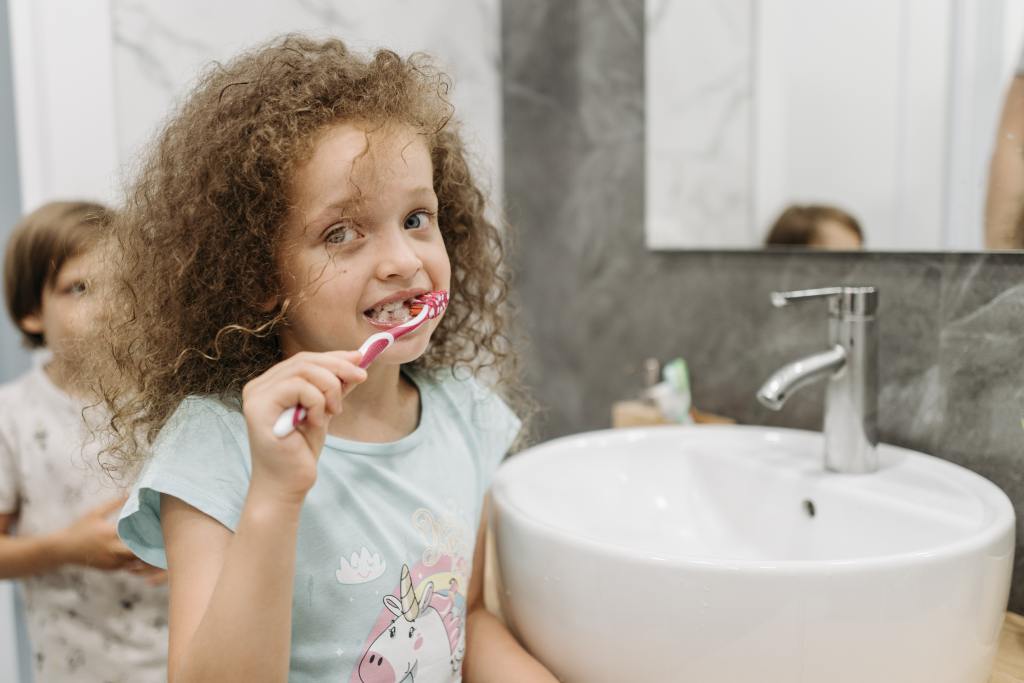
Tooth brushing and flossing are simple but crucial to keep your child’s mouth healthy. Make sure to brush for 2 Minutes 2X’s a day and floss every night with your child to establish a healthy brushing routine.
Not sure how much toothpaste to use or what brand?
For elementary school children, for each brushing it’s best to use a small green pea size amount of toothpaste on their brush. The toothpaste brand is really a personal preference, however, what’s most important is to use a fluoride containing toothpaste (with the ADA Seal of Acceptance).
How long will you need to brush and floss your child’s teeth?
Your child may want to brush their own teeth, but they need help until they have good coordination with their hand skills. Expect to brush and floss your child’s teeth or help them brush their teeth until they are at least 10 years old. A good way to gauge this is when they can wash, rinse, and style their hair totally on their own.
How do meals and snacks affect children’s teeth?
Serve healthy meals and snacks like fruits, vegetables, low-fat milk and dairy products, whole-grains, lean meat, fish, chicken, eggs, and beans. It’s also important to limit the number of snacks your child has in a day.
The more often children snack or are offered unhealthy food and beverage choices, the more likely they are to have cavities.
Be your child’s HERO
Be your child’s role model for oral health. Brush your own teeth 2Min 2X’s a day with fluoride toothpaste (in the morning and at bedtime) and floss once a day (before bedtime brushing).
How To Brush Your Children’s Teeth
4 Steps make it easy, BUT 5 make it fun
- Place a small green pea size amount of fluoride toothpaste on their brush and place their toothbrush against their gum line,
- Hold their toothbrush at a 45 degree angle to their gum line to make sure you’ll be reaching the gum line and each tooth,
- Move their toothbrush gently in circles as you move along the gum line and over each tooth surface,
- Before your bedtime brushing, floss between their teeth to remove what the brush won’t reach,
- Make it fun by playing their favorite song and brush to the tune!




6 Reasons Your Child’s Teeth Are Important To Keep Healthy
- Eating – Eating healthy foods promotes good nutrition and a healthy weight. Children who have cavities are less likely to want to eat because their teeth hurt.
- Speaking clearly – Teeth, tongue and mouth muscles help make speech sounds like f, s, sp, v, t, and th.
- Keeping space for their adult teeth to grow in – If a tooth (or teeth) is lost early the surrounding teeth move into that space and block the incoming tooth out. This causes issues later on as the adult tooth tries to come into their mouth.
- Staying healthy – Sometimes children don’t know how to tell their parents that their teeth hurt. That doesn’t mean that the pain isn’t real. As cavities grow they can cause pain, swelling and significant infections which can affect other parts of the body.
- Being able to focus and learn – When teeth hurt performance in school suffers. Keeping teeth healthy allows children to pay attention in school.
- Self-confidence – Have you seen a child that doesn’t smile? Keeps their hand over their mouth when they’re talking? Doesn’t want to play or raise their hand in class? They’re probably hiding the cavities on their teeth that they don’t want anyone to see.






What To Remember
Oral health is an important part of your child’s overall health and well-being. Children who have good oral health tend to eat well, sleep well, grow well, and learn well. By introducing and establishing a daily brushing and flossing routine in childhood, you are laying the foundation of good oral health for your child’s lifetime.
What’s your toothbrushing routine? How do you stay on track? Tell us, We’d really like to know! Send us an email to kidstoothhotline@proton.me Like Us or Chat with us on Facebook at facebook.com/kidstoothhotline
More tips? We have lots. We’re here just for kids!

 kidstoothhotline